By Brij Khandelwal / Vrindavan Today News
May 8th 2026, Agra: How many foundation stones does it take to build one barrage?
And how long can a river wait before it forgets how to flow?
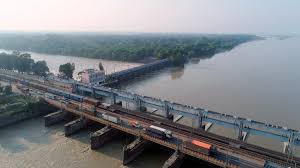
In Agra, the answers hang in the air like summer dust. Three foundation stones. Years of announcements. Countless assurances. Yet not a single functional barrage on the Yamuna downstream of the Taj Mahal.
The river still limps along. The monument still watches. And the gap between promise and performance keeps widening.
For years, the Yamuna barrage project has lived a strange double life. On paper, it exists in files, proposals, and political speeches. On the ground, it exists nowhere. It is a project that is always “coming soon,” like a train that never arrives but is forever announced.
This is not just delay. It is drift. Slow, stubborn, and strangely accepted.
India can build expressways that slice through states in record time. Bridges rise where rivers once divided. Airports appear where fields once stood. Yet here, beside one of the world’s most recognised monuments, a relatively straightforward, though environmentally sensitive, river project remains stuck in neutral.
It won’t be built of stone, nor rubber. It’s made of promises; a castle in the air. In the Taj’s shadow, the Yamuna dies. Files shuffle, vows multiply, but the river stays dry.
Why?
Because the system often prefers ceremony over completion. Announce first. Applaud loudly. Clarify later. And when the questions come, call it “due process.”
The idea of a barrage near the Taj is not trivial. It carries the weight of multiple expectations. Revive the Yamuna. Improve the Taj’s setting. Recharge groundwater. Ease ecological stress. Offer the city a breath of relief.
In a place where the river often resembles a sluggish drain more than a living waterway, this is not a luxury project. It is a necessity.
Yet the journey from idea to execution has been anything but smooth. Files have moved. Then stopped. Designs have changed. Then changed again. Departments have nodded. Then disagreed. The classic Indian refrain echoes through the corridors: “not my file.”
And so, the project waits. And waits.
At one stage, a rubber check dam was proposed as a quicker, more flexible solution. It sounded practical. It promised speed. But now, that idea has been quietly set aside in favour of a masonry dam, a more durable, long-term structure.
On paper, that sounds like progress. In reality, it resets the clock.
A new design means new studies. New studies mean new clearances. New clearances mean new delays. The cycle begins again, like a wheel stuck in mud, spinning without moving forward.
Meanwhile, the Yamuna continues its slow retreat. In some stretches, it thins out so much that you wonder whether policymakers are looking at the same river that citizens see every day.
There is no debate about the stakes.
The Taj Mahal is not just marble and memory. It is a living landscape. Its beauty depends not only on its structure but also on its surroundings, are the river, the air, the light, the subtle balance of environment.
A dying Yamuna is not just an eyesore. It is a warning.
A depleted river affects the local microclimate. It impacts groundwater. It changes the ecological rhythm of the region. Over time, it even threatens the integrity of the monument’s setting.
This is why activists, conservationists, and concerned citizens have raised alarms for years. Campaigns like the River Connect initiative have tried to keep the issue alive. Voices have spoken. Reports have been written. Appeals have been made.
But somewhere between concern and commitment, momentum is lost.
Now comes another twist.
With the shift to a masonry dam, the project must pass through a fresh round of scrutiny. Environmental Impact Assessment. Pollution control approvals. Groundwater evaluations. Heritage clearances due to proximity to the Taj.
None of these are unnecessary. In fact, they are essential. A project near a monument of global importance cannot cut corners.
But here lies the real problem, not the safeguards, but the speed.
In India, safeguards often become speed breakers. What should be a coordinated, time-bound process turns into a slow relay race where the baton keeps falling.
A project of this scale should move with urgency and clarity. One empowered authority. One timeline. Clear accountability. Regular public updates.
Instead, it drifts through departments like a forgotten file on a dusty desk.
The deeper issue is not technical. It is political.
Attention comes in bursts. When the Taj makes headlines, the Yamuna is remembered. When the news cycle shifts, so does the focus.
The result? A pattern that feels all too familiar. Announce. Delay. Reassure. Repeat.
It is governance by echo.
And then comes the irony, sharp, almost painful.
Foundation stones have been laid. More than once. Ceremonies held. Photographs taken. Speeches delivered.
But a barrage is not built with ceremonial shovels.
It is built with sustained effort. With discipline. With follow-through. The unglamorous grind of administration that rarely makes headlines but actually creates results.
Let’s be clear. This is not a vanity project.
A functioning barrage can stabilise water levels. It can improve the river’s visual and ecological presence near the Taj. It can support groundwater recharge in a city that desperately needs it.
Will it solve every environmental problem in Agra? No. But it is a meaningful step. And sometimes, meaningful steps matter more than perfect plans.
There is also a cost to waiting. Every year of delay deepens public frustration. It erodes trust. It sends a quiet message that even critical projects can drift endlessly without consequence.
And the river? It keeps shrinking. Silently. Patiently. Relentlessly.
So where does this leave Agra?
At a crossroads. Again.
The city does not need another announcement. It does not need another ceremonial launch. It does not need another promise wrapped in optimism.
It needs execution.
It needs a project that survives beyond speeches. Beyond photo-ops. Beyond political cycles.
Because in the end, the Yamuna does not read files. It does not attend meetings. It does not wait for approvals forever.
It simply flows.
Or it stops.