Braj Is a Sacred Landscape, Not Just a Transport Corridor
Vrindavan Today | Bureau Report
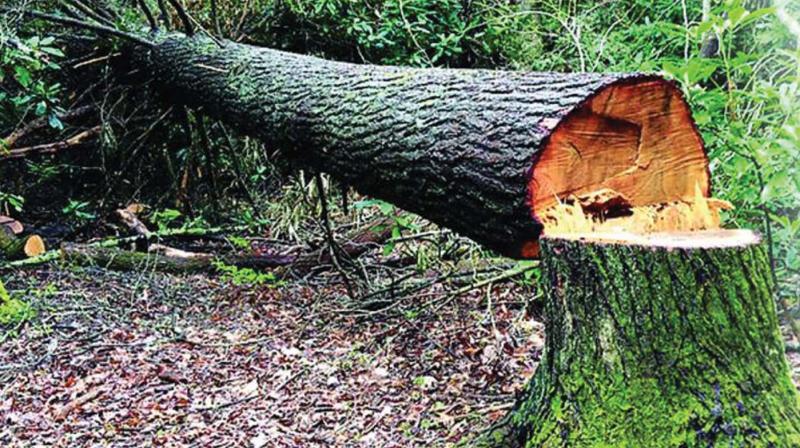
6th July, 2026, Mathura: Two major road-widening proposals in the Braj region have brought infrastructure development into direct conflict with environmental conservation. Together, the projects could result in the felling of 1,187 mature trees, raising serious concerns about the future of Braj’s rapidly disappearing green cover.
The first proposal involves the widening of the 3.5-kilometre Barsana–Unchagaon road, an important pilgrimage route connecting Barsana with Unchagaon, the birthplace of Lalita Sakhi and onward to Nandgaon. The Public Works Department (PWD) has sought permission from the Supreme Court to cut 51 mature trees for the ₹20.06 crore project. A site inspection by the Supreme Court’s Central Empowered Committee (CEC) is expected before any decision is taken.
Far more alarming, however, is the proposal to convert the 18-kilometre Mathura–Bharatpur Road (State Highway-33) into a four-lane highway. Stretching from Narholi Tiraha near Mathura to the Rajasthan border, this route is a major corridor connecting Rajasthan with Mathura, Agra and Delhi and carries increasing traffic, particularly during Braj’s religious festivals.
The road, presently about 10 metres wide, is proposed to be expanded to 16 metres, with dual carriageways separated by a central divider. The road construction alone is estimated to cost ₹207 crore. However, the actual project cost will be significantly higher, as it also includes the felling of 1,136 mature trees, relocation of electricity infrastructure, and acquisition of land for compensatory afforestation. The proposal has been submitted to the State Government for approval, after which permission for tree felling will be sought from the Supreme Court. As with the Barsana project, the CEC will inspect the site before making its recommendation.

Development Without Ecology Is Not Development
Authorities justify these projects by citing increasing traffic and the growing number of pilgrims visiting Braj. While safer and more efficient roads are undoubtedly needed, the repeated assumption that mature trees are expendable reflects a deeply outdated approach to development.
Every one of these 1,187 trees represents decades; perhaps generations of natural growth. They provide shade to pilgrims walking the sacred landscape, lower ambient temperatures during Braj’s scorching summers, absorb air pollutants, sequester carbon, recharge groundwater, stabilize the soil, and provide habitat for birds and countless other species. These ecosystem services cannot be replaced by planting saplings elsewhere.
Compensatory plantation has become a convenient justification for large-scale tree felling, yet ecological science tells a different story. A newly planted sapling requires decades before it can perform even a fraction of the ecological functions of a mature tree. Many plantation drives also suffer from poor survival rates, making the promise of “ten trees for every one cut” largely symbolic unless monitored over many years.
The Supreme Court may, in many cases, permit the felling of trees subject to conditions such as compensatory afforestation. However, if the replacement trees are planted several kilometres away from the original site, they cannot compensate for the lost greenery, shade, biodiversity, groundwater recharge, temperature regulation, and other ecological benefits that the mature trees provided to that specific area.
The best substitute for a mature tree is its preservation in its original location. The value of a tree is determined not merely by its number, but also by its location, age, and the vital ecological services it provides. True development should therefore be measured not by the number of trees sacrificed, but by our ability to protect them while pursuing progress.
Braj Is a Sacred Landscape, Not Just a Transport Corridor
Braj is revered not only because of its temples, but because of its ancient groves, village roads shaded by trees, sacred hills, kunds, and the living landscape associated with the pastimes of the Divine Couple of Shri Radha – Krishna. Pilgrims come here seeking an experience rooted in nature and spirituality, not endless stretches of concrete.
Ironically, while governments are investing heavily in climate resilience, urban greening and carbon reduction, mature roadside trees continue to be sacrificed for infrastructure projects without seriously examining less destructive alternatives. Better engineering, narrower alignments where feasible, bypasses, traffic management, speed regulation, and redesigning road geometry should all be explored before approving irreversible environmental damage.
The Supreme Court’s Central Empowered Committee now has an opportunity to ensure that development in Braj follows the principles of environmental sustainability rather than administrative convenience. Infrastructure projects in ecologically and culturally sensitive regions must be designed to avoid tree loss wherever possible and minimise it where unavoidable.
The widening of roads may make journeys faster, but if it comes at the cost of destroying Braj’s green heritage, the region risks losing the very landscape that has inspired saints, pilgrims and poets for centuries.
Once a mature tree falls, no engineering project, however expensive, can restore its ecological value within our lifetime. The real challenge before policymakers is not whether roads should be widened, but whether Braj’s priceless natural heritage will be allowed to survive alongside development.