The environment has become a Kurukshetra: Will humanity save its own home?
- By Brij Khandelwal
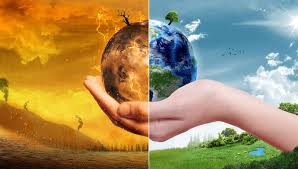
2026.03.02 (Vrindavan Today News): Climate summits are all the rage around the world. Students are writing essays. Queues are forming. Stages are decked out. Pledges are being read aloud. Applause echoes. But the Earth is scorching. Poison seeps into the air. The weather’s temperament has gone haywire.
2025 was the world’s third hottest year. Average temperatures hit 1.34°C above pre-industrial levels. Oceans have absorbed 90% of the excess heat. Atmospheric CO₂ levels have crossed 422 ppm—nearly 50% higher than before the industrial era. Emissions aren’t falling; they’re rising.
The question is straightforward: Is this just a failure of policies? Or of our intentions?
India’s civilization points to a different path. Vasudhaiva Kutumbakam, the whole Earth is one family. This isn’t just diplomatic rhetoric; it’s a moral imperative. The Maha Upanishad declares: “Ayan nijah paro veti ganana laghuchentasam.” Those tangled in “mine and yours” have small hearts.
Today’s carbon nationalism is the new face of that narrowness. Developed nations dodge responsibility for historical emissions. Developing ones demand their right to growth. But in this debate, the screams of sinking islands get drowned out. Scientists warn that sea levels will rise further in coming decades. Nations like Tuvalu and Kiribati are fighting for survival.
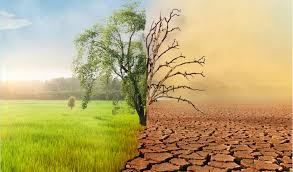
In the Indian worldview, nature isn’t a resource, it’s a relationship. “Mata bhoomih putro’ham prithivyah”; the Earth is our mother, and we are her children. But today, this child is choking its own mother.
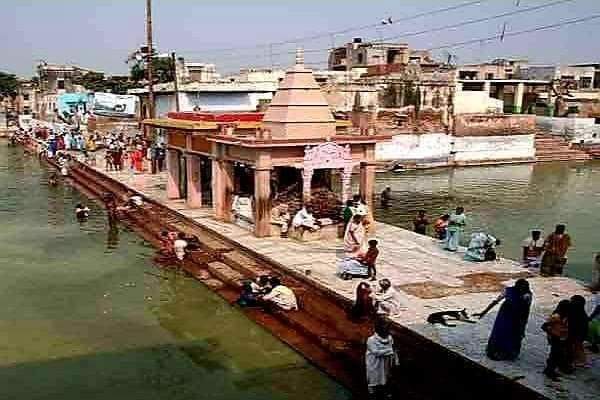
The Ganga, which we call the liberator of souls, is itself pleading for salvation. The Ganga basin discharges thousands of million liters of sewage daily, much of it untreated into the river. In Varanasi, fecal coliform levels are several times above safe limits. Faith’s rituals and pollution’s flow run side by side.
In the Ramayana, Lord Ram seeks the ocean’s permission to build the bridge. Even in war, respect for nature. Today, in the name of development, we slice mountains, divert rivers, and raze forests. In 2024, India lost about 1.5 lakh hectares of natural forest. This isn’t just tree-felling; it’s a rupture in the carbon balance.
Religion isn’t ritual; it’s equilibrium. The order of creation. When that balance breaks, crisis is born. Climate change is the fruit of that adharma.
Rabindranath Tagore wrote, “The same stream of life that runs in my veins runs in the world.” We’ve dammed that stream. Turned rivers into sewers. Air into smoke. Soil into poison.
Mahatma Gandhi gave us the principle of trusteeship. Resources aren’t for private plunder, they’re society’s trust. He warned: “The Earth can satisfy every person’s need, but not greed.” Today, this reads like a climate policy manifesto.
His swaraj spoke of self-reliant villages. Local energy. Balanced production. Limited consumption. Today’s blind consumerist race stands in stark opposition.
Recent UN assessment reports warn that with current policies, temperatures could rise 2.5°C or more by century’s end. The 1.5°C limit is slipping away. That means even fiercer heat, floods, droughts, cyclones.
Swami Vivekananda said, “Every soul is divine.” If every soul is divine, then every creature, every forest, every river deserves respect. So why our silence on vanishing species?
In the Mahabharata, when greed triumphed over wisdom, destruction unfolded on Kurukshetra. Today’s climate battle is a modern Kurukshetra. On one side, endless consumption. On the other, the call of conscience.
Climate politics often shrinks to bargaining: Who cuts how much? Who gets how much funding? Indian thought raises a different question: Is this just? Is this righteous?
Leadership isn’t just setting targets, it’s building character. It’s thinking beyond GDP, about the breaths of future generations.
The crisis is global. The solution must be moral. Technology is essential, but not enough. Laws are necessary, but not sufficient.
In the end, climate change is not a question of the thermometer, but of the conscience.
Will humanity truly act like a family?
Or keep debating while the house burns around us?