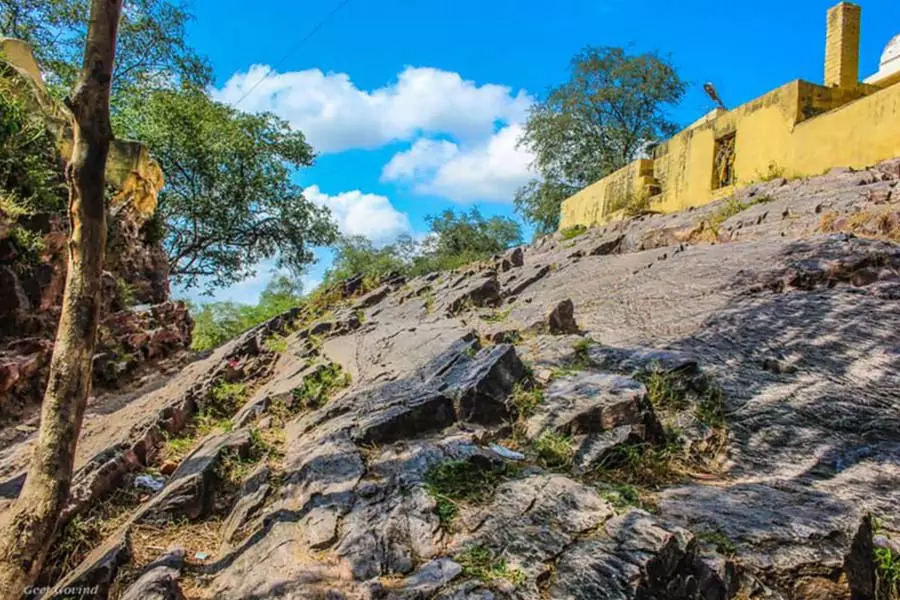
2026.03.12 (Vrindavan Today News): Faith and folklore often blend seamlessly with the landscape of Braj. One such fascinating place lies in the town of Barsana, revered as the birthplace of Radha. Here, a narrow mountain passage known as Sankari Khor continues to attract visitors who claim to experience the mysterious fragrance of butter and curd from the very rocks themselves.
Interestingly, India has another curious natural phenomenon somewhat related to this. About 40–50 kilometers from Jaisalmer lies a village called Habur. Stones found there, locally known as Habur Stone or Haburiya Bhata, are believed to have the remarkable property of turning milk into curd without the use of a starter culture. When placed in milk, locals say, the milk naturally coagulates and forms yogurt. While the scientific explanation of this phenomenon remains debated, it has long fascinated villagers and visitors alike.
Back in Braj, Sankari Khor is situated on the slopes of the Brahmanchal Hill, one of the twin hills that form the sacred geography of Barsana. The passage itself is extremely narrow; hence the name Sankari (narrow) and Khor (gorge or lane). According to traditional belief, during the era described in the Mahabharata, often associated with the divine pastimes of Shri Krishna, the milkmaids of Braj would pass through this very lane carrying pots of butter, curd, and milk to the marketplace.
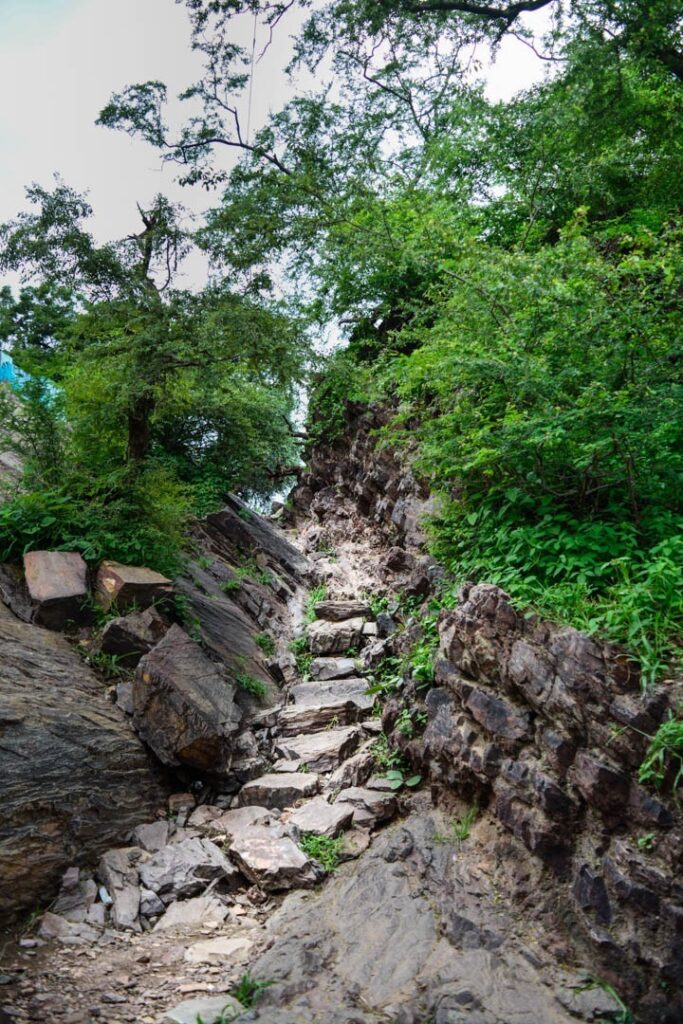
It is said that young Krishna, accompanied by his cowherd friends, would often stop the gopis here and demand butter. Playful arguments and mock struggles sometimes followed, during which butter and curd would spill onto the surrounding rocks. Devotees believe that the fragrance of those divine pastimes still lingers in the stones.
Visitors to Sankari Khor often test this belief themselves. Many rub their palms against the rocks and then smell their hands, claiming they can sense the aroma of butter and curd. For devotees, this is not merely imagination but a reminder of the living presence of Shri Krishna’s pastimes in the sacred land of Braj.
Another striking feature of this narrow passage is the contrasting color of the rocks on either side. One side appears dark, while the other is noticeably fair. Devotees associate this with the divine couple. They believe the darker rocks mark the places where Krishna once sat, while the fair-colored stones are believed to have been touched by Shri Radha.
Although modern science does not support these devotional interpretations, the cultural and spiritual significance of the site remains profound.
Historical references to this hill date back to the 16th century, when the sacred geography of Braj was extensively documented by saints and scholars during the revival of Krishna devotion. However, like the nearby Govardhan Hill, the Brahmanchal hill of Barsana is widely believed to be far more ancient.
Archaeological evidence from the region also suggests a very old human presence. Several important markings and carvings have been found on rocks in and around Sankari Khor. In addition, inscriptions from the medieval period (16th–17th centuries) written in the Braj language and the Devanagari script have been discovered in temples and along ancient hill paths in Barsana.
About three kilometers from Barsana lies the village of Hathiya, where archaeological surveys have revealed remains belonging to the Painted Grey Ware culture, an archaeological culture dated roughly between 1200 and 800 BCE. This period is often associated by some historians with the later Vedic or epic era.
Further evidence of the region’s deep antiquity comes from excavations conducted by the Archaeological Survey of India in the nearby village of Bahaj, close to Govardhan. The excavation, among the deepest carried out in the area, uncovered traces of a civilization nearly 4,500 years old. Artifacts included stone tools associated with the ancient Ganeshwar–Jodhpura culture as well as implements from the Stone Age, indicating that the region has been a center of human activity for thousands of years.
Thus, the hills of Barsana are not only sacred to millions of devotees but also rich with layers of history and archaeology. Whether viewed through the lens of faith, folklore, or science, places like Sankari Khor continue to remind visitors that the landscape of Braj holds stories that stretch across millennia—stories where devotion, memory, and mystery still linger in the very stones.