By Brij Khandelwal
Vrindavan Today | Bureau Report
25thMarch 2026 New Delhi / Vrindavan: The Supreme Court’s recent blunt reminder that rivers like the Yamuna are “national assets” deserving protection should have shaken the political class awake. Instead, it merely restated what every citizen already sees: our rivers have been reduced to open sewers, their floodplains colonised, their beds choked with silt, and their waters poisoned by untreated waste. The court’s observations on the Yamuna could serve as a mirror for every major river in the country.
The Supreme Court of India said rivers like the Yamuna River are national assets and must be protected.
It expressed concern over untreated sewage and industrial waste flowing from Delhi, Noida, and Ghaziabad into the Yamuna.
The court noted a failure of multiple authorities across regions to control pollution, allowing waste to move through interconnected waterways.
It emphasized the need for a coordinated, multi-agency response, directing the Central Pollution Control Board to identify all responsible bodies.
A comprehensive treatment plan for sewage and effluents was described as urgent to prevent further damage and protect river systems.
The court also involved the state of Haryana, asking it to report on steps to stop pollution entering the Yamuna and its tributaries.
In essence: the court’s message is blunt, rivers are shared lifelines, and fragmented governance is killing them; only coordinated action can save them.
The Supreme Court of India declared rivers like the Yamuna as national assets requiring urgent protection. It voiced strong concerns over untreated sewage and industrial waste from Delhi, Noida, and Ghaziabad polluting the river via interconnected waterways. Highlighting failures by multiple regional authorities, the court stressed the need for a coordinated multi-agency effort. It directed the Central Pollution Control Board to pinpoint all responsible bodies and mandated a comprehensive plan for sewage and effluent treatment to avert further damage. Haryana was also roped in, tasked with reporting actions to curb pollution in the Yamuna and its tributaries. Bluntly, the court warned that fragmented governance is devastating these shared lifelines, only unified action can revive them.
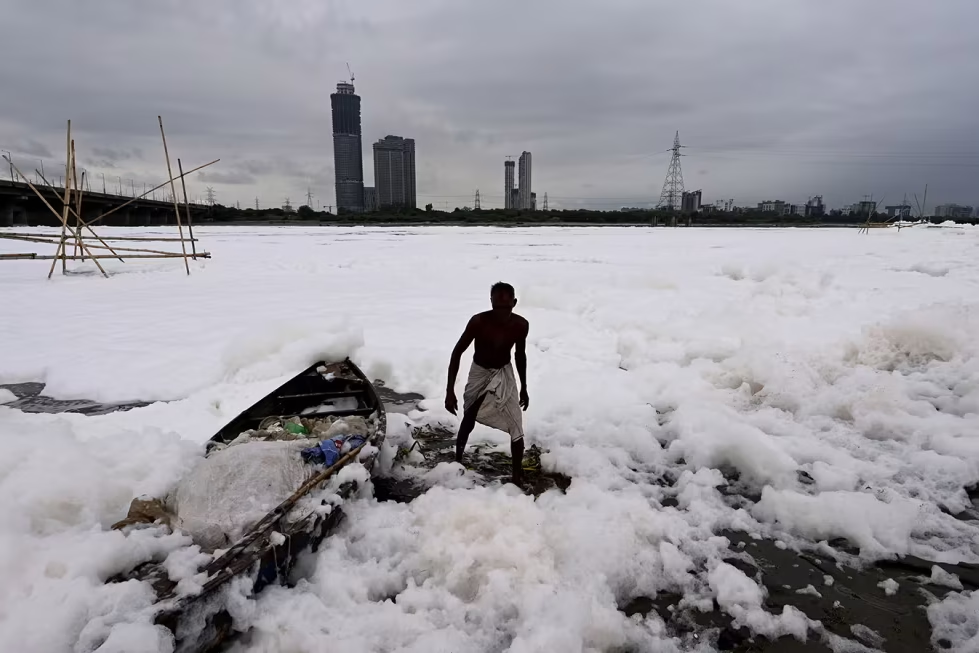
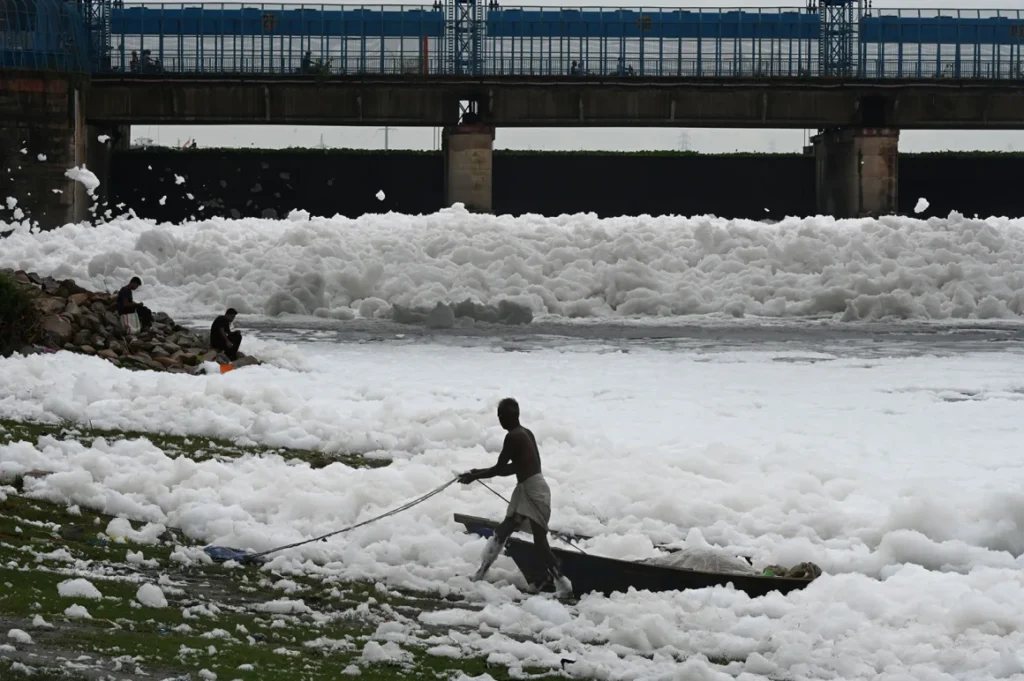
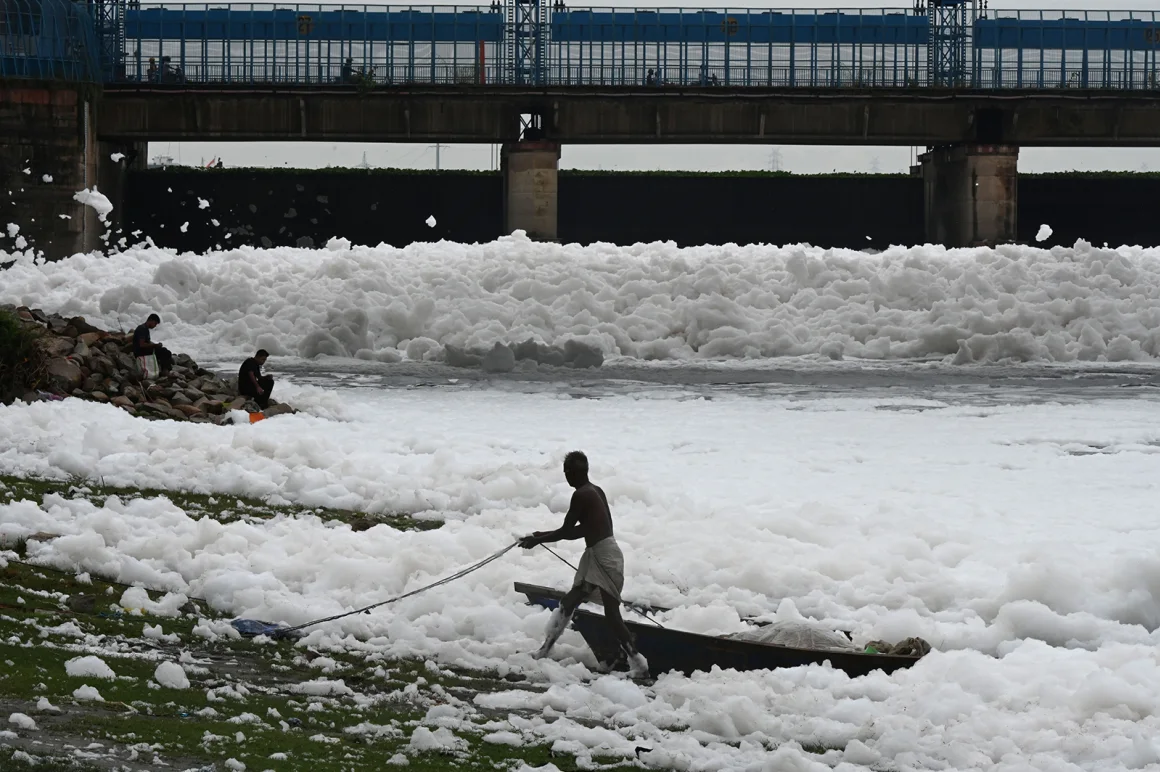
Picture this: a river screaming in silence. No flute melodies from Krishna’s banks, just the gurgle of toxic sludge. No holy dips for devotees, only skin-burning foam. This is the Yamuna, Braj’s beating heart, the dark-skinned companion of legends, now reduced to a gasping drain. Black as ink, reeking like a sewer, it’s not flowing; it’s festering. These aren’t mere photos; they’re indictments etched in filth. The real question? Do we even want to save her?
The numbers hit like a slap. In Delhi, fecal coliform levels have skyrocketed to 92,000—37 times the safe limit. Ammonia? A poisonous 27.4 mg/L. Biochemical oxygen demand (BOD)? A lethal 70 mg/L, when anything over 3 spells death for aquatic life. Dissolved oxygen? Near zero—fish float belly-up in this brew. Microplastics swarm like invisible assassins: 6,375 particles per cubic meter pre-monsoon, still 3,080 after rains. We’re not tracking health metrics; we’re witnessing murder by metric.
Promises? They’ve drowned in the river itself. The Yamuna Action Plan guzzled thousands of crores, yet sewage treatment plants idle like broken promises, half-built, underfed, or spewing half-treated slop. Delhi alone dumps 28 million gallons of raw sewage daily into her veins. Drains laugh at “interception” efforts, pouring industrial effluents and household waste unchecked. By Mathura and Vrindavan, she’s a weary corpse, hauling Delhi’s dirt to Agra, where the Taj Mahal gazes mournfully at its poisoned reflection. Locals still wash clothes in it, cattle stumble through it, crops thirst for it, groundwater now laced with the same venom. Untouchable. Undrinkable. A slow poison seeping into Braj’s soul.
Environmentalists don’t mince words: “The Yamuna is virtually dead in Mathura and Agra,” declares the River Connect Campaign. Dry beds scar the landscape, ghats echo with abandonment, boatmen trade oars for despair. Pilgrims recoil from the “sacred” touch. Upstream barrages starve her flow, how does a river heal without water? Industries dump with impunity; over half of Delhi’s waste evades rules through sheer neglect. This isn’t accident; it’s apathy, a moral bankruptcy where faith meets filth.
Braj isn’t just losing a river, it’s hemorrhaging heritage. Mathura’s kirtans, Vrindavan’s rasleelas, Gokul’s childhood games, all tethered to Yamuna’s banks. A dying river erodes their essence, scripting a legacy of shame for our kids: poisoned playgrounds over paradise.
Zoom out, and the tragedy swells national. Five decades post-first clean-up drives, India’s rivers, from Himalayan snowmelt to Deccan rains, gasp under sewage, silt, and indifference. The Supreme Court recently thundered: rivers like Yamuna are “national assets.” Yet politicians snooze as floodplains sprout slums, beds clog with silt, and waters morph into open sewers.
Northward, the Ganga mirrors the mess. Namami Gange burned billions but left Varanasi’s ghats drowning in foam. Fragmented agencies, municipalities, pollution boards, states, point fingers while toxins cruise from Haridwar to the sea. Yamuna’s filth from Delhi-Noida-Ghaziabad-Haryana chokes interconnected channels, embarrassing the Taj and mocking its love story.
Southward, it’s déjà vu with new names. Godavari, the “Southern Ganga,” swallows Nashik and Rajahmundry’s untreated waste, its plains devoured by sprawl. Krishna’s industrial runoff from Maharashtra-Karnataka-Andhra spawns dead zones. Cauvery’s court battles ignore Bengaluru’s sewage deluge. Mahanadi and Pennar in Odisha-Andhra battle silt, plastics, and neglect. Himalayas to plateau, the diagnosis is uniform: political paralysis masquerading as “federalism.” Pollution ignores borders, Ghaziabad’s sludge hits Agra, then Bengal.
The Court nailed it: accountability fractures across states. Yamuna Plans flopped; Haryana’s now in the dock. But naming culprits won’t dredge the depths. We need a ironclad national policy, treating rivers as shared lifelines, not state bargaining chips.
Here’s the blueprint: four must-dos, no excuses:
Zero Untreated Discharge by 2030: Time-bound sewage plants with real-time tracking, centrally enforced.
National Desilting Blitz: Funded by a River Rejuvenation Cess, restoring flow via dredging.
Floodplain Fortress: Satellite-monitored, zero-encroachment with instant demolitions.
National River Authority: Statutory powerhouse overriding laggards, uniform standards, heavy fines from CMs to commissioners.
Without this, Yamuna will taunt the Taj eternally, Ganga will betray Varanasi, southern streams will whisper their deaths. Data damns us; the Court commands. Will leaders treat rivers as vote fodder or vital veins? Piecemeal flops end now. One policy, one command, one deadline, from peaks to seas. Saving Yamuna isn’t charity; it’s survival. Her cry is ours, will we listen?