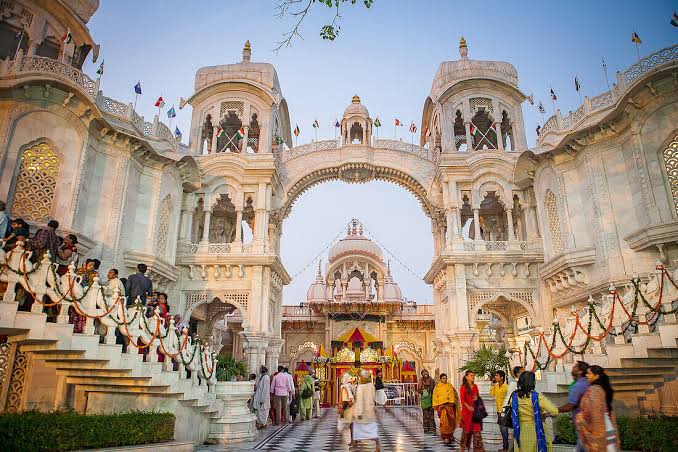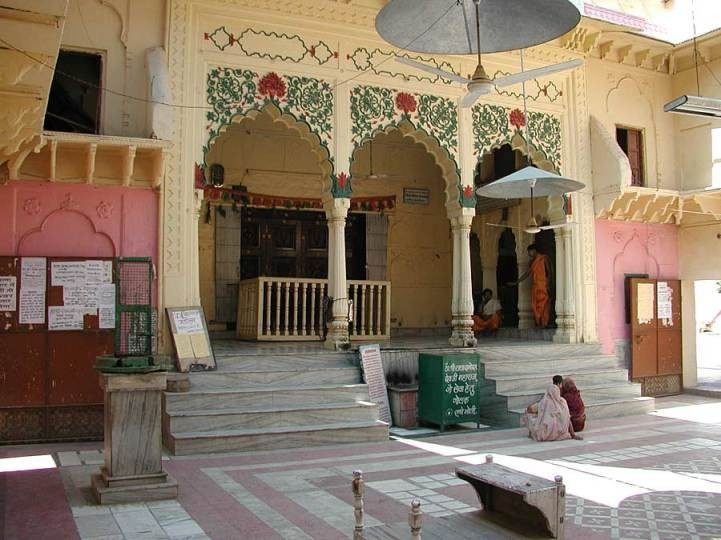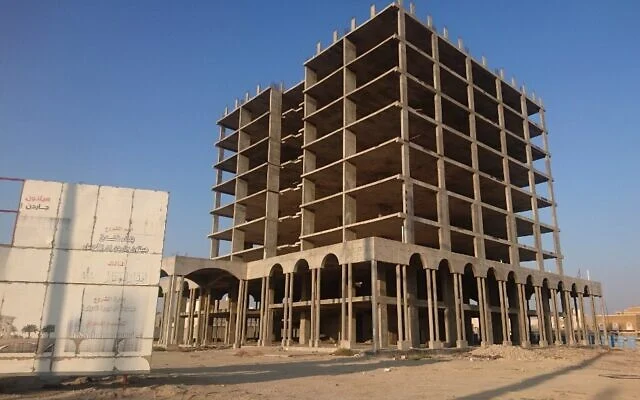
2026.02.06 (Vrindavan Today News): Behind the rhetoric of “planned development” and “tourism infrastructure,” a quieter but far more consequential transformation is unfolding in Vrindavan. Under the guise of land-use conversion, large sections of this ancient pilgrimage town are being systematically commercialized, threatening not only its environment but its very spiritual identity.
Vrindavan has, for centuries, drawn pilgrims seeking devotion to the Lordships of Vrindavan, silence over spectacle, and renunciation over consumption. Today, however, the city is witnessing the rapid rise of hotels, commercial complexes, and tourism-oriented infrastructure—often in zones originally earmarked for religious, residential, or ecological purposes.
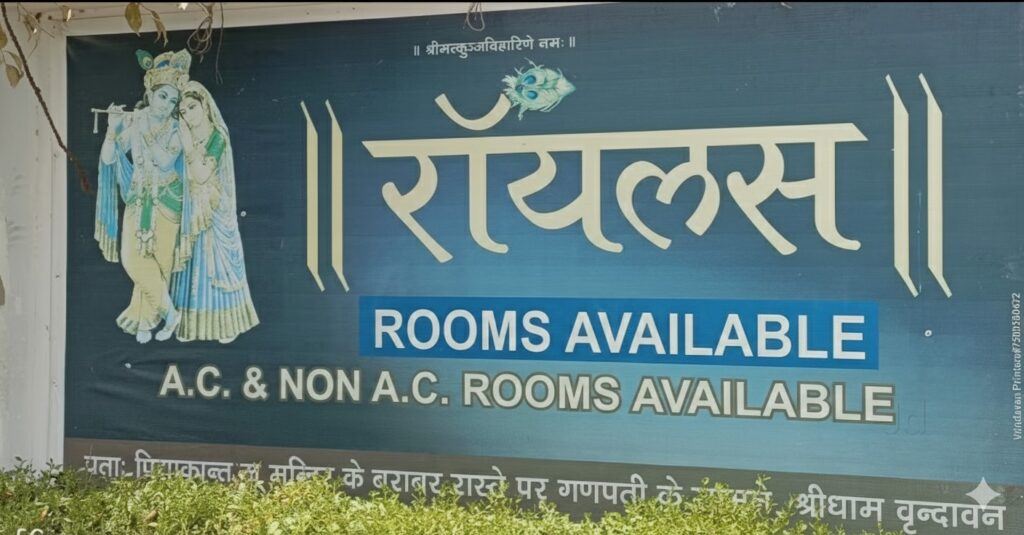
From Sacred Soil to Star Hotels The most visible symbol of this transformation is Raman Reti, an area traditionally revered for its sanctity. Once cherished by devotees for its sacred soil, Raman Reti is now ringed by three-star hotels and commercial establishments. Several of these facilities reportedly operate bars and entertainment services fundamentally incompatible with the devotional ethos of the town.
This raises a critical question: who is permitting such activity in areas historically protected for religious and spiritual use? And under what legal framework are these permissions being granted?
Master Plan 2031: A Plan Undermine from within The Mathura–Vrindavan Master Plan 2031 was designed as a blueprint for balanced, regulated development. In practice, however, the same authority has been tasked with enforcing the plan. Interestingly, the Mathura–Vrindavan Development Authority (MVDA) is being accused of hollowing it out.
Over the past two to three years, MVDA has approved a surge of commercial building plans that allegedly contradict the zoning and land-use designations laid out in the master plan itself. These approvals are often issued through public notices, a procedural mechanism that, critics argue, is being used to legitimize what are effectively policy reversals.
Land categorized as residential, agricultural, green belt, sector park, knowledge park, community-use land, and even forest or open space is increasingly being converted for commercial use. Once a master plan is finalized, deviating from it through piecemeal approvals raises serious governance concerns. If the master plan can be bypassed so easily, does it have any regulatory value at all?
The Nexus: Rising Land Prices and Regulatory Capture
Soaring land prices driven by mass tourism have created fertile ground for land mafias, colonizers, and real estate developers. Local activists allege that this ecosystem thrives with the tacit or active support of sections of the administrative machinery.
The result is a form of regulatory capture, where public planning instruments are repurposed to serve private commercial interests. Ashram and monastery lands, traditionally safeguarded for spiritual use, are reportedly being repackaged into revenue-generating assets.
Environmental Collapse in Slow Motion
The environmental consequences are already visible. Forest cover across the Mathura district is shrinking. Tree felling has become commonplace. Groundwater levels are falling steadily, and traditional water bodies i.e ponds, stepwells, and wetlands are disappearing under encroachments.
Air quality has also deteriorated sharply. The rising AQI is not an abstract statistic but a public health emergency, particularly for children and the elderly. Yet, critics say environmental clearances and cumulative impact assessments are either weakly enforced or altogether ignored in the approval process.
Courts Have Spoken—But Are They Being Heard?
Judicial precedent on this issue is unambiguous. The Supreme Court of India and the Allahabad High Court have repeatedly ruled that commercial activity in residential zones is unauthorized. The National Green Tribunal (NGT) has also intervened in cases where commercial development has led to environmental degradation.
Despite these rulings, commercial approvals continue. It is often justified under “zoning regulations.” This creates a troubling legal paradox: are zoning regulations being interpreted as superior to court orders, or are judicial directives being systematically sidelined?
Legal Challenges and Official Response
A Public Interest Litigant who filed a PIL in 2022, alleges that since 2021–22, MVDA has approved commercial maps in violation of the master plan, defeating its very purpose. The case led to the summoning of senior officials, including the MVDA Vice Chairperson and the Municipal Commissioner.
In response to growing criticism, MVDA Vice Chairperson N. Lakshmi has stated that constructions violating the master plan are being identified and that notices have been issued. She has assured strict action against illegal constructions.
However, residents and activists remain skeptical. They argue that selective enforcement after construction is complete cannot substitute for preventive regulation. The damage to heritage, ecology, and social fabric is often irreversible.
A City at a Crossroads
Vrindavan stands at a critical juncture today. The question is no longer whether development is needed, but what kind of development is being pursued and at whose cost?
If current trends continue, Vrindavan risks becoming a spiritual brand stripped of substance: a town where devotion is marketed, not practiced; where sacred geography survives only in brochures and planning documents.
For a city revered as eternal in India’s civilizational imagination, the erosion underway is neither inevitable nor accidental. It is the result of choices—administrative, political, and economic. And those choices demand scrutiny.