Vrindavan Today | By Shyaamantakaa (Olga Soloveva)
Vrindavan has always been a land where devotion transcends convention. Here, spiritual realization has often outweighed social custom, and history is replete with saints whose lives defied ordinary expectations in their unwavering pursuit of Sri Krishna. The sacred groves of Braj have witnessed kings renouncing kingdoms, scholars abandoning worldly prestige, and ascetics embracing lives of complete surrender. Against this backdrop emerged one of the most remarkable personalities of contemporary Vrindavan—Meenakshi Goswami, whose life represented an extraordinary synthesis of tradition, hereditary duty, and personal devotion.
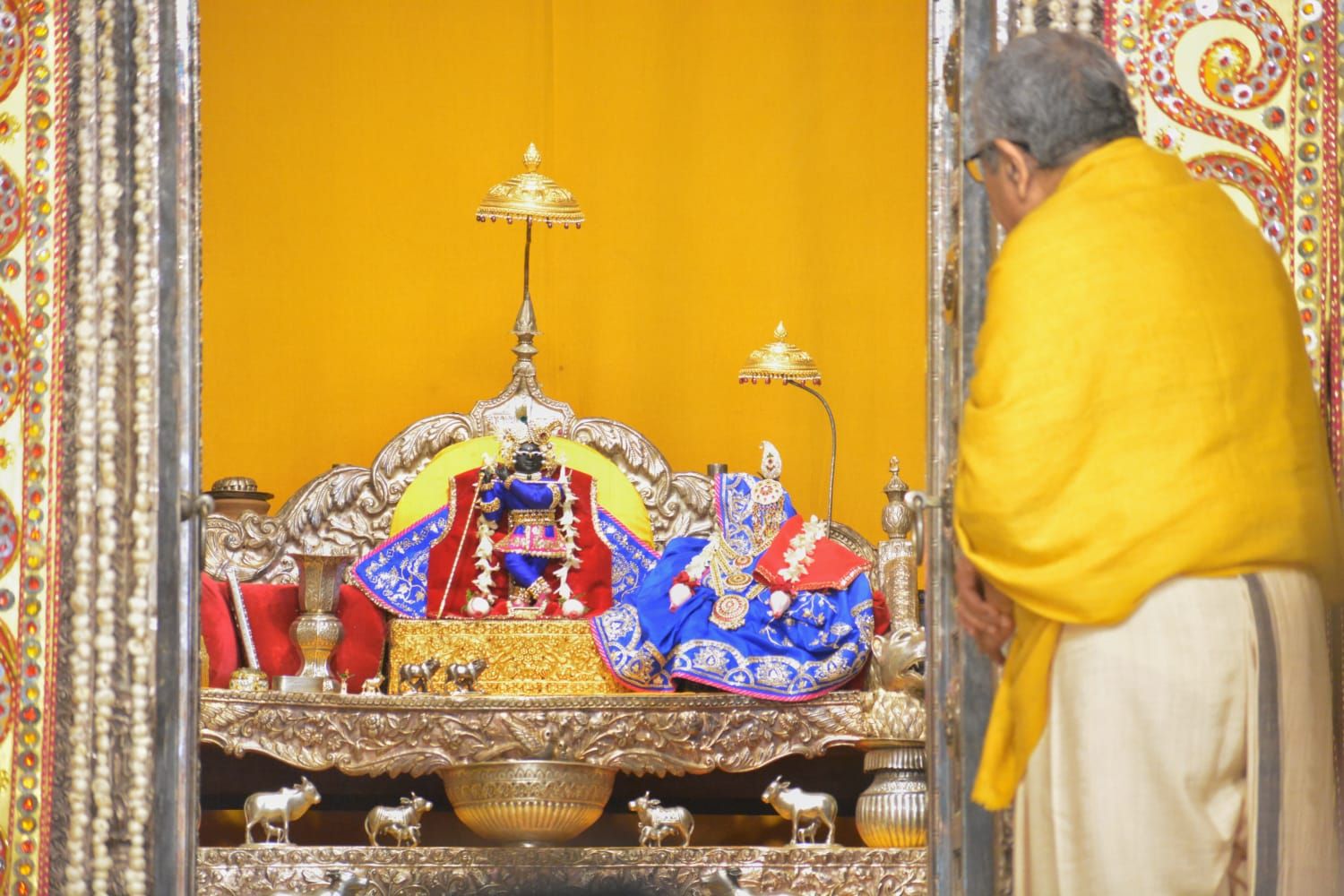
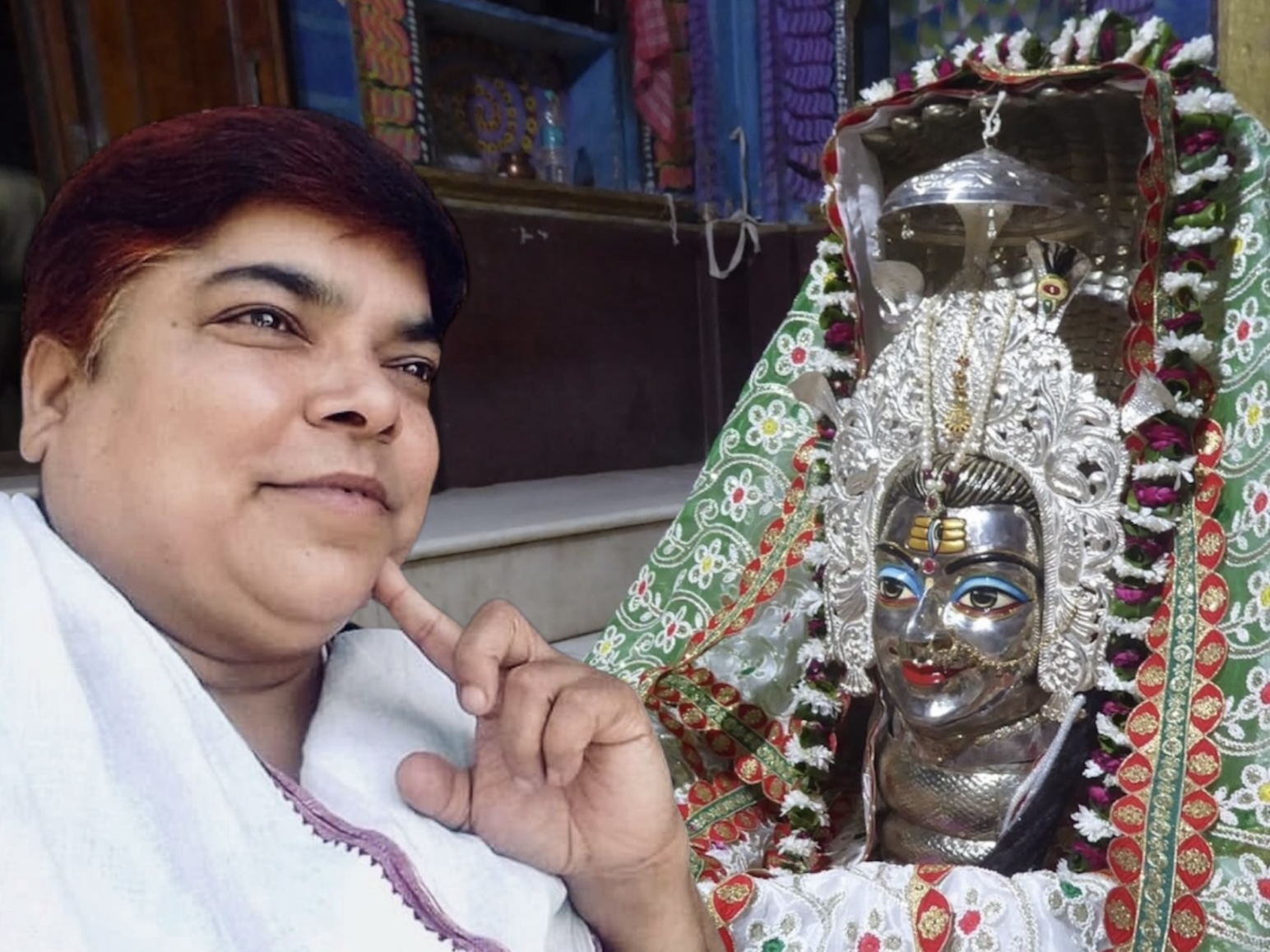
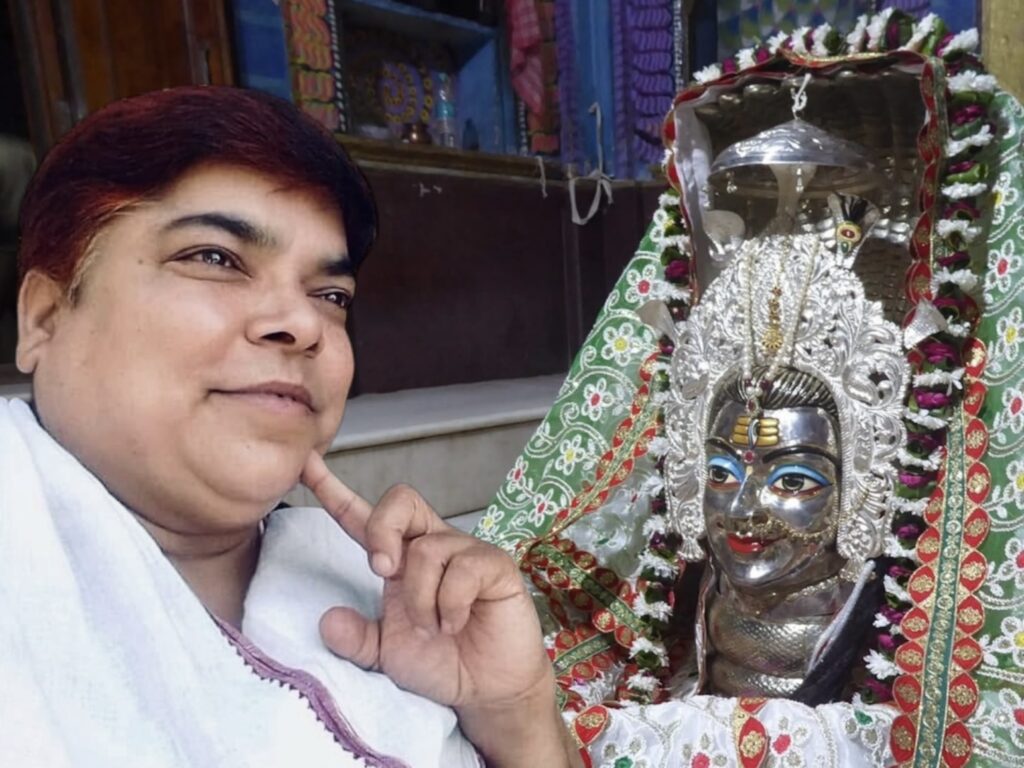
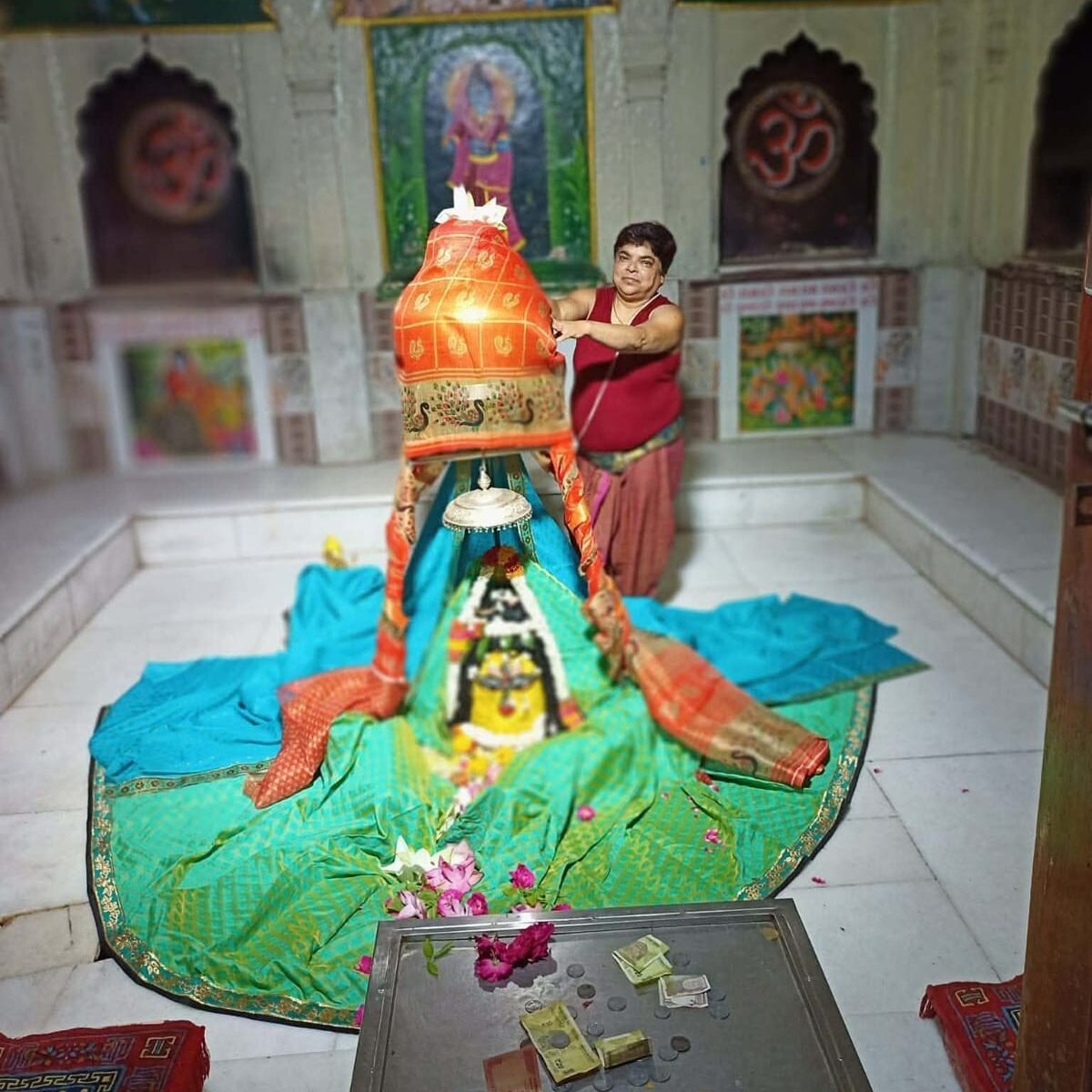
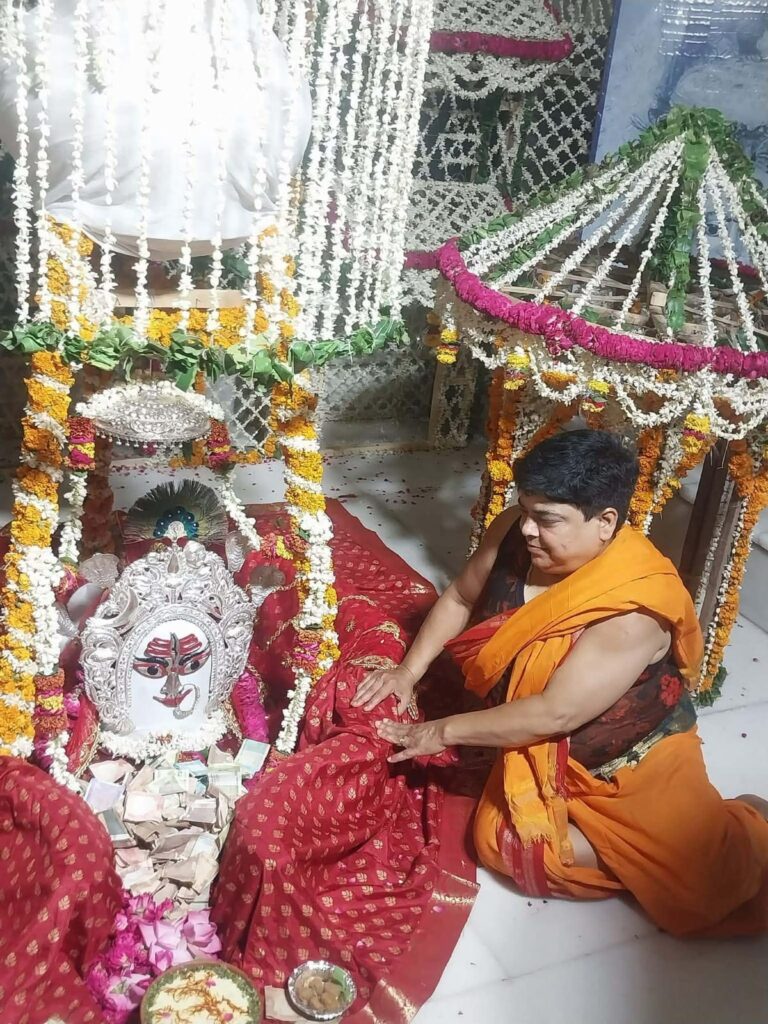
To many pilgrims, she was an unforgettable sight. Wearing a dhoti, upper cloth (uttariya), tilak, and the Janeu (sacred thread)—the traditional external symbols of a Brahmin priest—she moved confidently through the precincts of the ancient Gopeshwar Mahadev Temple, directing temple affairs, supervising rituals, and overseeing development projects. Visitors unfamiliar with the temple’s history were often surprised to discover that this respected priestly figure was, in fact, a woman.
In most Hindu temples, such an image would have been almost inconceivable. Traditional Vedic customs generally reserve the sacred thread and formal priestly functions for men. Yet in the unique spiritual atmosphere of Gopeshwar Mahadev, Meenakshi Goswami’s presence was accepted not as a challenge to tradition but as a continuation of it.
Understanding this remarkable acceptance requires looking beyond outward appearances. It was the product of a rare convergence of hereditary lineage, temple theology, lifelong service, and the distinctive devotional culture of Braj. Her position cannot be explained by any single factor; rather, it emerged from what may rightly be described as a “perfect storm” of exceptional circumstances that are unlikely to be replicated elsewhere.
The Authority of Kul-Parampara
The foundation of Meenakshi Goswami’s position lay in Kul-Parampara, the hereditary tradition through which seva is transmitted within Goswami families.
Across Braj, many ancient temples have been served for centuries by families entrusted with the worship of specific deities. Their responsibility is not regarded as employment but as a sacred inheritance. The right to perform seva is passed down from one generation to the next, preserving rituals exactly as they have been performed for hundreds of years.
Meenakshi Goswami was born into one such distinguished family. She was the daughter of Ram Gopal Goswami, the Mahant and head priest of the historic Gopeshwar Mahadev Temple. From childhood she grew up immersed in temple life, observing the daily worship, the festivals, and the responsibilities that accompany the guardianship of one of Vrindavan’s most revered shrines.
In many traditional Braj temples, when a Mahant does not have a son available to continue the hereditary service, a daughter may assume responsibility for preserving the family’s sacred trust. Although the formal priestly rituals continue to be performed according to established tradition, the daughter may become the temple’s Sevadhaari—the person responsible for protecting the institution, supervising its services, managing its administration, and ensuring the continuity of its heritage.
This was precisely the role Meenakshi Goswami assumed.
Her authority therefore did not arise from a reinterpretation of scripture or from any social movement advocating changes in temple customs. It rested firmly upon hereditary right and the confidence placed in her by the Goswami lineage itself.
She became the custodian of the temple’s traditions, its administration, and its future.
A Temple Unlike Any Other
If hereditary succession explains how Meenakshi Goswami came to occupy her position, the unique theology of Gopeshwar Mahadev explains why her presence resonated so profoundly with devotees.
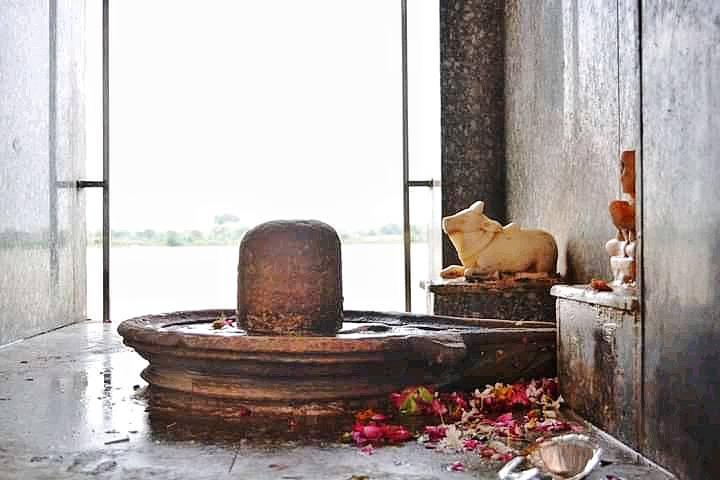
Among the countless temples dedicated to Lord Shiva across India, Gopeshwar Mahadev occupies a singular place.
According to the sacred traditions of Braj, when Lord Shiva desired to witness the divine Rasa Lila of Sri Krishna, he was prevented from entering because only the Gopis could participate in that most intimate expression of divine love. Determined to receive Krishna’s grace, Shiva bathed in the sacred waters of Manasarovar (according to another tradition, the Yamuna) and assumed the form of a Gopi before being permitted to enter the Rasa Mandala.
This transformation remains central to the identity of the temple.
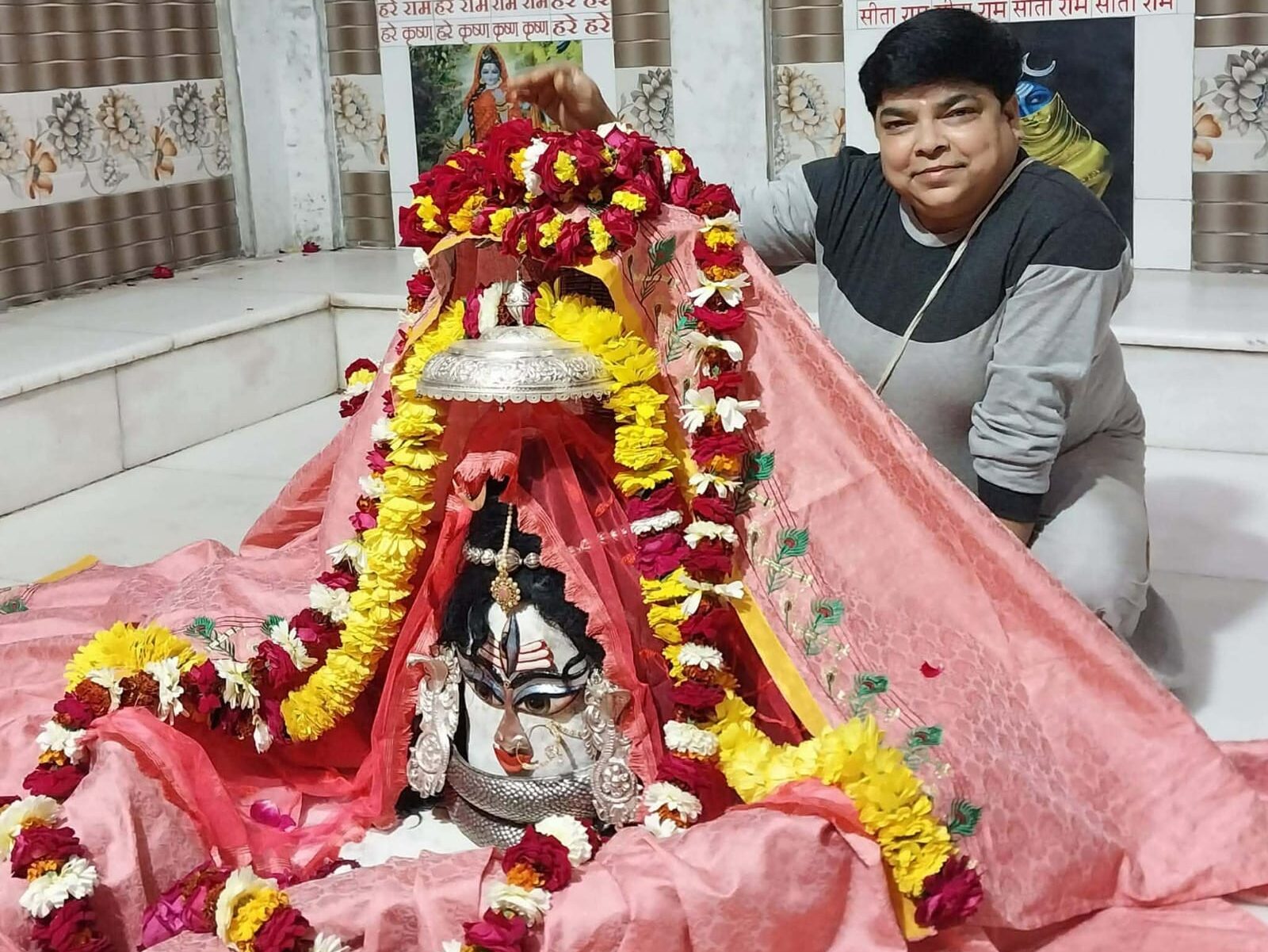
Every evening, during the celebrated Shringar Seva, the Shiva Lingam is adorned in feminine attire—a sari, ornaments, flowers, and even a nose ring—symbolizing Shiva’s eternal identity as Gopeshwar, the Lord who became a Gopi to experience Krishna’s transcendental pastimes.
This ritual is not a theatrical performance or symbolic innovation. It is the living expression of one of Braj’s most cherished theological traditions.
Understanding Gopi Bhava
The tradition of Gopi Bhava lies at the heart of Gaudiya Vaishnava spirituality.
Its essential teaching is that approaching Sri Krishna requires complete surrender of the false ego. Since the Gopis embody the highest and purest form of selfless love for Krishna, advanced devotees meditate upon serving Him in their mood of loving devotion.
In this context, external bodily identity becomes secondary. The aspirant seeks not to imitate the Gopis physically but to cultivate their spirit of unconditional love and surrender.
Lord Shiva’s transformation into a Gopi represents this highest ideal of humility. The supreme male deity willingly abandoned every trace of masculine pride in order to enter the service of Krishna.
It is one of the most profound examples of devotional surrender found anywhere in Hindu theology.
The Remarkable “Double Inversion”
Within this extraordinary theological setting, Meenakshi Goswami’s own life assumed an almost mirror-like symbolism.
The deity she served represented one extraordinary transformation.
Lord Shiva—the ultimate Purusha, or Supreme Male—accepted the external appearance of a Gopi in order to attain Krishna’s grace.
Meenakshi Goswami represented the exact opposite visual transformation.
She was a woman who adopted the attire and external markers traditionally associated with male Brahmin priests—the sacred thread, the dhoti, the upper cloth, and priestly dress.
The result was what might be called a remarkable double inversion.
The deity embodied the movement from male to female for the sake of devotion.
The servant embodied the adoption of traditionally male priestly symbols in order to fulfil hereditary service.
Far from contradicting one another, these two images appeared to complement each other perfectly within the unique atmosphere of Gopeshwar Mahadev.
Together they silently proclaimed a deeper philosophical truth—that the soul’s relationship with God transcends bodily identity.
In the spiritual vision of Braj, every Atma is feminine in relation to the Paramatma, Sri Krishna. The physical distinctions of male and female belong to the temporary material body, while the eternal identity of the soul is that of a servant of the Divine.
From this perspective, Meenakshi Goswami’s life became an extraordinary reflection of the deity she served.
Just as Lord Shiva demonstrated that a male body need not prevent one from attaining the mood of a Gopi, Meenakshi Goswami demonstrated that a female body need not prevent one from carrying the sacred responsibilities traditionally associated with a Brahmin priest when hereditary duty and lifelong seva called for it.
Neither sought to overturn tradition.
Both illustrated that the highest purpose of every external identity is ultimately seva.
Sevayat of Gopeshwar Mahadev—A Life of Service Beyond Ritual
The uniqueness of Meenakshi Goswami’s life cannot be understood merely by looking at her distinctive appearance. The dhoti, the sacred thread (Janeu), and the upper cloth were only the visible symbols of a much larger commitment. Her true identity was defined by seva—unceasing, selfless service to Gopeshwar Mahadev and to the thousands of devotees who visited the temple every day.
Although visitors often referred to her as the temple’s “lady priest,” her role was far broader than that of a conventional pujari. In the traditional structure of the Gopeshwar Mahadev Temple, the daily worship and ritual offerings continued to be performed by the male sevayats of the Goswami family according to established custom. Meenakshi Goswami’s position was that of the temple’s Sevadhaari—a guardian, administrator, organizer, supervisor, and protector of one of Braj’s oldest and most revered shrines.
Her responsibilities touched virtually every aspect of the temple’s functioning.
Guardian of the Temple’s Most Sacred Tradition
Among the countless rituals performed at Gopeshwar Mahadev, none is more famous than the evening Shringar Seva.
Every evening, the Shiva Lingam is transformed into the form of a Gopi. Draped in a beautiful sari and adorned with jewellery, flowers, bangles, and a nose ring, Gopeshwar Mahadev reminds devotees of the eternal pastime in which Lord Shiva assumed feminine form to enter Sri Krishna’s Rasa Lila.
This daily ceremony is not simply decorative; it is the spiritual heart of the temple.
Meenakshi Goswami was deeply involved in this celebrated Shringar. She supervised its arrangements with meticulous care, ensuring that every ornament, every garment, and every detail reflected the dignity and sanctity of the tradition handed down through generations of Goswami families.
To thousands of pilgrims, the evening darshan of Gopeshwar Mahadev dressed as a Gopi became one of the most unforgettable spiritual experiences of their visit to Vrindavan. Behind that beautiful daily offering stood years of Meenakshi Goswami’s quiet and dedicated service.
Supervising the Morning Abhishek
Her service began long before sunrise.
Every morning, from approximately 4:00 a.m. until noon, the temple witnesses an uninterrupted stream of devotees performing Abhishek by offering sacred Yamuna water over the Shiva Lingam.
During festivals and auspicious days, thousands of pilgrims gather to participate in this ancient ritual.
Managing such an enormous flow of worshippers requires discipline, organization, and constant supervision. Arrangements must ensure that devotees receive their opportunity for darshan while preserving the sanctity of the temple and maintaining the smooth conduct of worship.
Meenakshi Goswami personally supervised these logistical arrangements. Though the ritual itself was performed according to traditional priestly customs, she ensured that every aspect of the temple’s daily operation functioned efficiently.
Her service demonstrated that preserving a sacred tradition often depends as much upon careful administration as upon ritual itself.
More Than a Caretaker
To describe Meenakshi Goswami merely as a temple administrator would be to underestimate the breadth of her contribution.
She viewed herself as the custodian of an ancient spiritual institution whose responsibility extended far beyond the performance of daily worship.
Under her stewardship, attention was given to preserving the temple’s architectural heritage, improving facilities for pilgrims, maintaining the temple premises, and ensuring that Gopeshwar Mahadev continued to occupy the central place it has held in the spiritual geography of Vrindavan for centuries.
Visitors rarely saw the countless hours devoted to planning, coordination, maintenance, and problem-solving that made the temple function smoothly.
Like many true servants of sacred institutions, much of her work remained invisible.
A Vision for Development
One of Meenakshi Goswami’s most significant contributions lay in her vision for the temple’s physical development.
She believed that preserving an ancient shrine required not only safeguarding its rituals but also maintaining its infrastructure for future generations.
With remarkable determination, she spearheaded efforts to refurbish and beautify the temple, particularly its garbha-griha, the sanctum sanctorum where Gopeshwar Mahadev resides.
These projects required extensive planning, coordination, and, above all, financial support.
Rather than waiting for resources to appear, she actively mobilized devotees and well-wishers to contribute towards the preservation of the temple.
Her fundraising efforts enabled several important developmental initiatives that enhanced both the beauty and functionality of the shrine while respecting its ancient character.
For her, temple development was never an exercise in modernisation for its own sake. It was an act of devotion—a means of offering the very best to the deity.
Leadership Through Service
Those who worked with Meenakshi Goswami often observed that her authority arose naturally from service rather than position.
She did not seek prominence, yet she became one of the most respected figures associated with Gopeshwar Mahadev.
Her decisions carried weight because they were rooted in decades of personal sacrifice and unwavering commitment to the temple.
Among devotees, temple staff, local residents, and many of Braj’s senior citizens, she earned a reputation for integrity, dedication, and reliability.
This respect proved invaluable whenever major projects required cooperation or collective effort.
Whether supervising rituals, coordinating temple maintenance, or undertaking ambitious development works, she inspired confidence because people knew that every decision was motivated by the welfare of the temple rather than personal interest.
Service Above Self
In Hindu thought, seva is not merely work performed in a sacred place.
It is worship expressed through action.
Meenakshi Goswami embodied this understanding throughout her life.
Her daily routine revolved around the needs of the temple rather than personal convenience. Festivals, pilgrim management, restoration projects, ceremonial preparations, and countless administrative responsibilities became inseparable from her own spiritual practice.
For decades, she quietly devoted herself to ensuring that devotees experienced Gopeshwar Mahadev in an atmosphere worthy of the sacred traditions of Braj.
Her contribution therefore cannot be measured solely by rituals performed or buildings restored.
It is measured by the continuity she preserved.
Ancient temples survive across centuries not only because of their legends, but because generation after generation of dedicated individuals silently dedicate their lives to protecting them.
Meenakshi Goswami belonged to that rare lineage of custodians whose greatest achievement was enabling an unbroken tradition of service to continue.
Her work demonstrated that the highest leadership in a temple is not exercised through authority alone, but through humility, responsibility, and unwavering devotion.
The sacred attire she wore may have attracted attention, but it was her tireless service that earned the enduring respect of Vrindavan.
Beyond Gender—How Braj Understood Meenakshi Goswami’s Extraordinary Identity
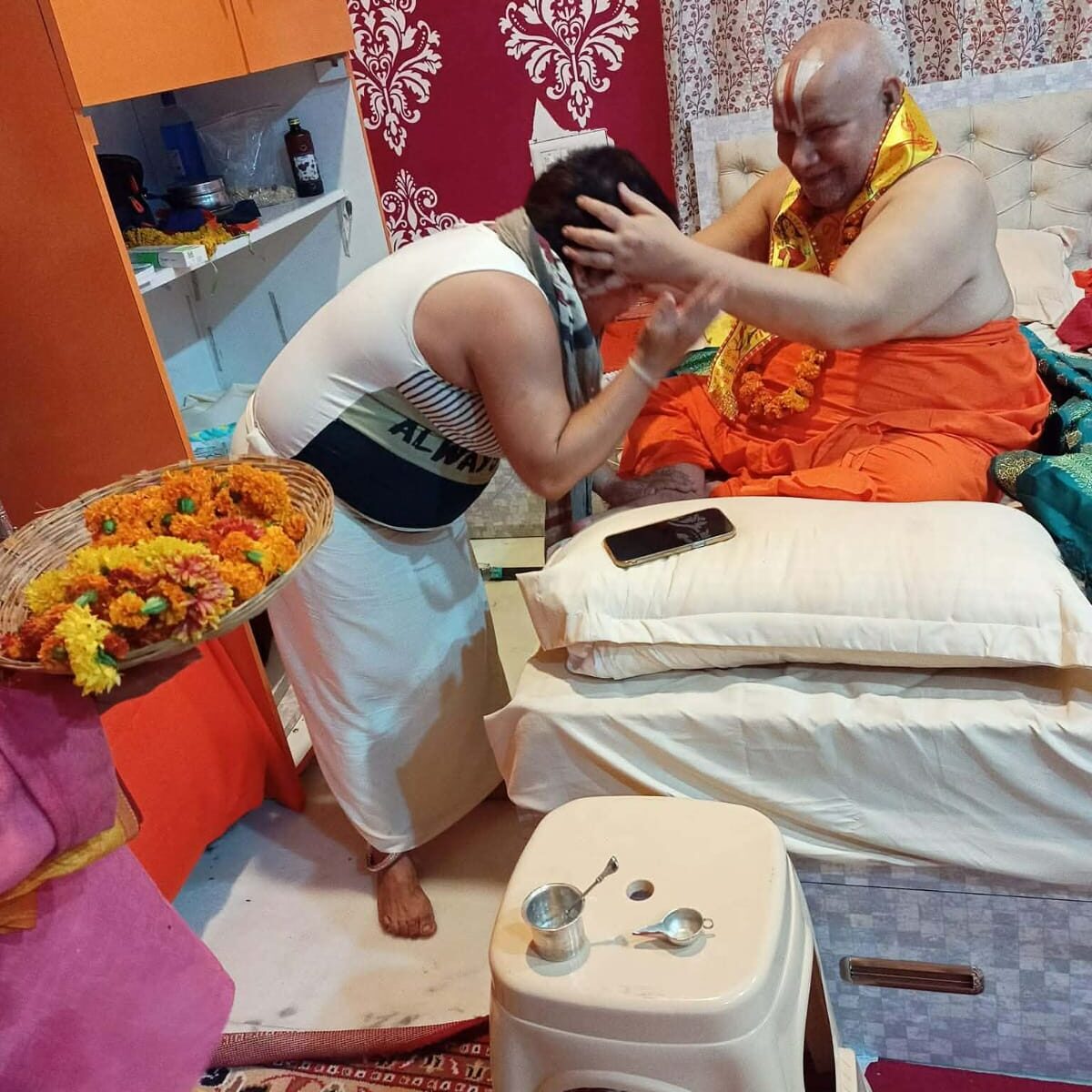
To an outsider, Meenakshi Goswami’s appearance could easily be interpreted as unconventional or even revolutionary. A woman wearing the Janeu, dressed in a dhoti and uttariya, bearing the tilak and visual identity of a Brahmin priest, seemed to challenge deeply rooted social conventions.
Yet those who knew Braj understood her very differently.
Her acceptance was not the result of a movement for social reform, nor did it arise from an attempt to redefine traditional temple practices. Instead, it grew organically from the distinctive devotional culture of Vrindavan, where sincere bhakti has long been regarded as more important than outward social identity.
Her life demonstrated how an exceptional individual, serving under exceptional circumstances in an exceptional temple, could be embraced without altering the fundamental traditions of the institution.
The Practical Meaning of Priestly Attire
In a traditional temple hierarchy, clothing is far more than a matter of personal preference.
The dhoti, sacred thread, upper cloth, and priestly tilak are instantly recognised throughout Hindu society as symbols of responsibility, discipline, and ritual authority. They identify the wearer as someone entrusted with sacred duties.
For Meenakshi Goswami, adopting this attire served both a spiritual and a practical purpose.
As the temple’s Sevadhaari, she interacted daily with thousands of pilgrims, temple employees, artisans, donors, local residents, and visiting saints. Every day required supervision, decision-making, and the management of numerous activities connected with the temple’s functioning.
By wearing the visual “uniform” traditionally associated with a Brahmin priest, she immediately communicated the office she represented.
The attire quietly conveyed a simple message:
“I am not here in a personal or social capacity. I am here as a consecrated servant of Gopeshwar Mahadev.”
In doing so, the focus shifted away from her gender and toward her responsibility.
Commanding Respect Through Service
In a pilgrimage centre that welcomes thousands of visitors every day, leadership often depends upon instant recognition.
Pilgrims naturally look to those wearing priestly symbols for guidance and instruction. Temple workers instinctively recognise those symbols as signs of authority.
Meenakshi Goswami’s attire therefore helped establish an atmosphere of clarity and order.
It enabled her to supervise temple affairs, coordinate workers, interact with visiting dignitaries, and manage large gatherings with confidence.
This was not authority imposed by appearance alone.
Rather, the attire complemented decades of dedicated service.
The external symbols reflected an inner commitment that had already earned the trust of the community.
Neutralising Gender Bias
Traditional societies often carry deeply ingrained expectations regarding the roles of men and women.
Meenakshi Goswami’s priestly attire had the practical effect of moving attention away from those expectations.
Instead of being perceived primarily as the daughter of the Mahant or as a woman performing unusual duties, she came to be recognised principally as the temple’s Sevadhaari.
Her office became more visible than her gender.
In many ways, this reflected one of the deepest teachings of the devotional traditions of Braj—that external bodily identity is temporary, while service to the Lord is eternal.
The respect she received arose not because society abandoned its traditions, but because her lifelong dedication transcended ordinary social categories.
Braj’s Capacity for Spiritual Exception
Vrindavan has always possessed a remarkable ability to accommodate exceptional expressions of devotion.
Its history is filled with saints whose lives defied conventional expectations.
Within Braj, there exists an understanding that overwhelming devotion may occasionally lead individuals to adopt ways of living that appear unusual to outsiders.
Such behaviour is often affectionately described as “pagalpan”—not ordinary madness, but a sacred absorption born of intense love for the Divine.
This expression carries a very different meaning from its everyday usage.
In the devotional vocabulary of Braj, it often refers to those whose love for Krishna has become so complete that worldly conventions naturally recede into the background.
Many devotees viewed Meenakshi Goswami through precisely this lens.
Her distinctive appearance was not interpreted as a rejection of tradition but as the natural expression of a life wholly absorbed in the service of Gopeshwar Mahadev.
A Rare Exception, Not a New Norm
It is important to understand that Meenakshi Goswami’s life did not establish a new model for temple priesthood.
Vrindavan is home to thousands of deeply respected women devotees.
Many widows spend their lives immersed in bhajan and kirtan, wearing the traditional white sari that has long been associated with renunciation and devotional simplicity.
Women from Goswami families and other Vaishnava traditions also contribute immensely to the spiritual life of Braj through worship, teaching, hospitality, service, and preservation of sacred customs.
Their paths reflect long-established traditions that continue to flourish.
Meenakshi Goswami represented something different.
Her role emerged from the unique combination of hereditary lineage, the absence of a male successor within her family, the extraordinary theology of Gopeshwar Mahadev, and decades of unquestioned service to the temple.
It was this rare convergence of circumstances that made her acceptance possible.
Rather than creating a precedent applicable everywhere, her life remained an exceptional chapter in the history of one exceptional temple.
The Living Reflection of the Deity
Perhaps the most striking aspect of Meenakshi Goswami’s life is how closely it reflected the theology embodied within Gopeshwar Mahadev himself.
Every evening, devotees witness Lord Shiva—the supreme male deity—adorned as a Gopi in order to commemorate his longing to participate in Sri Krishna’s Rasa Lila.
Standing before that same deity was Meenakshi Goswami—a woman bearing the external symbols traditionally associated with a Brahmin priest.
The parallel is impossible to overlook.
The deity moved symbolically from masculine identity to feminine form for the sake of devotion.
The servant adopted traditionally masculine priestly symbols in order to fulfil hereditary service.
Both silently proclaimed the same spiritual truth.
Before the Supreme Lord, external identity is secondary.
What ultimately matters is seva.
In this profound sense, Meenakshi Goswami did not merely serve Gopeshwar Mahadev.
She became, in her own remarkable way, a living reflection of the deity whose service defined her entire life.
For countless devotees who encountered her in the temple courtyard, she stood as a reminder that the deepest traditions of Braj have never been confined merely to external forms. They have always pointed beyond them, toward wholehearted surrender, unwavering devotion, and selfless service.
The Final Journey—An Irreplaceable Loss and an Enduring Legacy
For decades, Meenakshi Goswami’s life followed an unbroken rhythm of seva. Her days revolved around the temple, its rituals, its devotees, and its preservation. Whether supervising the famous evening Shringar Seva, overseeing arrangements for the morning Abhishek, coordinating restoration projects, or ensuring that every aspect of the temple functioned smoothly, she remained devoted to Gopeshwar Mahadev with remarkable consistency.
Few could have imagined that such a life of tireless service would come to such a sudden and tragic end.
On 8 May 2026, while returning after Mansarovar Darshan, Meenakshi Goswami met with a fatal road accident. The bicycle she was riding collided head-on with another bicycle. The accident claimed her life, bringing to an abrupt close a lifetime dedicated to one of Vrindavan’s most sacred temples.
The news spread rapidly through Braj.
For devotees, local residents, temple families, and countless pilgrims who had known her over the years, the loss was deeply personal. It was not merely the passing of an individual but the departure of a custodian whose presence had become inseparable from the daily life of Gopeshwar Mahadev.
A Void Beyond Administration
Ancient temples do not survive on rituals alone.
Behind every sacred institution stands an unbroken chain of dedicated individuals who quietly devote themselves to preserving traditions that have endured for centuries. Much of their work remains unseen by the public, yet without them, even the most ancient temples would struggle to maintain their continuity.
Meenakshi Goswami belonged to this rare lineage of silent guardians.
She represented institutional memory, hereditary continuity, administrative leadership, and spiritual dedication—all united in a single individual.
Her passing therefore created a void that extended far beyond the practical responsibilities she carried.
Those responsibilities could eventually be redistributed.
Her unique combination of experience, authority, devotion, and personal acceptance within the community could not easily be replaced.
An Exceptional Life in an Exceptional Temple
The story of Meenakshi Goswami should not be read simply as the biography of a remarkable woman.
Nor should it be interpreted merely as an exception to traditional social customs.
Rather, her life illustrates how India’s ancient temple traditions have occasionally accommodated extraordinary circumstances without abandoning their essential principles.
Her acceptance rested upon four interwoven foundations.
A Living Mirror of Gopeshwar Mahadev
Perhaps no aspect of Meenakshi Goswami’s life is more striking than the symbolic harmony between the deity and the devotee.
Every evening, Lord Shiva is worshipped as Gopeshwar, adorned as a Gopi who surrendered his masculine identity to attain the privilege of participating in Sri Krishna’s Rasa Lila.
Every day, the temple’s Sevadhaari appeared wearing the traditional symbols of a male Brahmin priest while dedicating her life to that very deity.
The parallel is extraordinary.
The deity revealed that a male body need not prevent one from entering the highest mood of devotion.
The devotee demonstrated that a female body need not prevent one from fulfilling hereditary responsibilities traditionally associated with Brahmin priests when circumstances and lineage called for it.
Together, deity and devotee proclaimed the same timeless truth of Braj.
The Atma is beyond bodily identity.
Its eternal purpose is seva.
In this sense, Meenakshi Goswami’s life became far more than a personal story. It became an illustration of the philosophy embodied within Gopeshwar Mahadev himself.