By Chandra Pratap Sikarwar
Vrindavan Today | Bureau Report
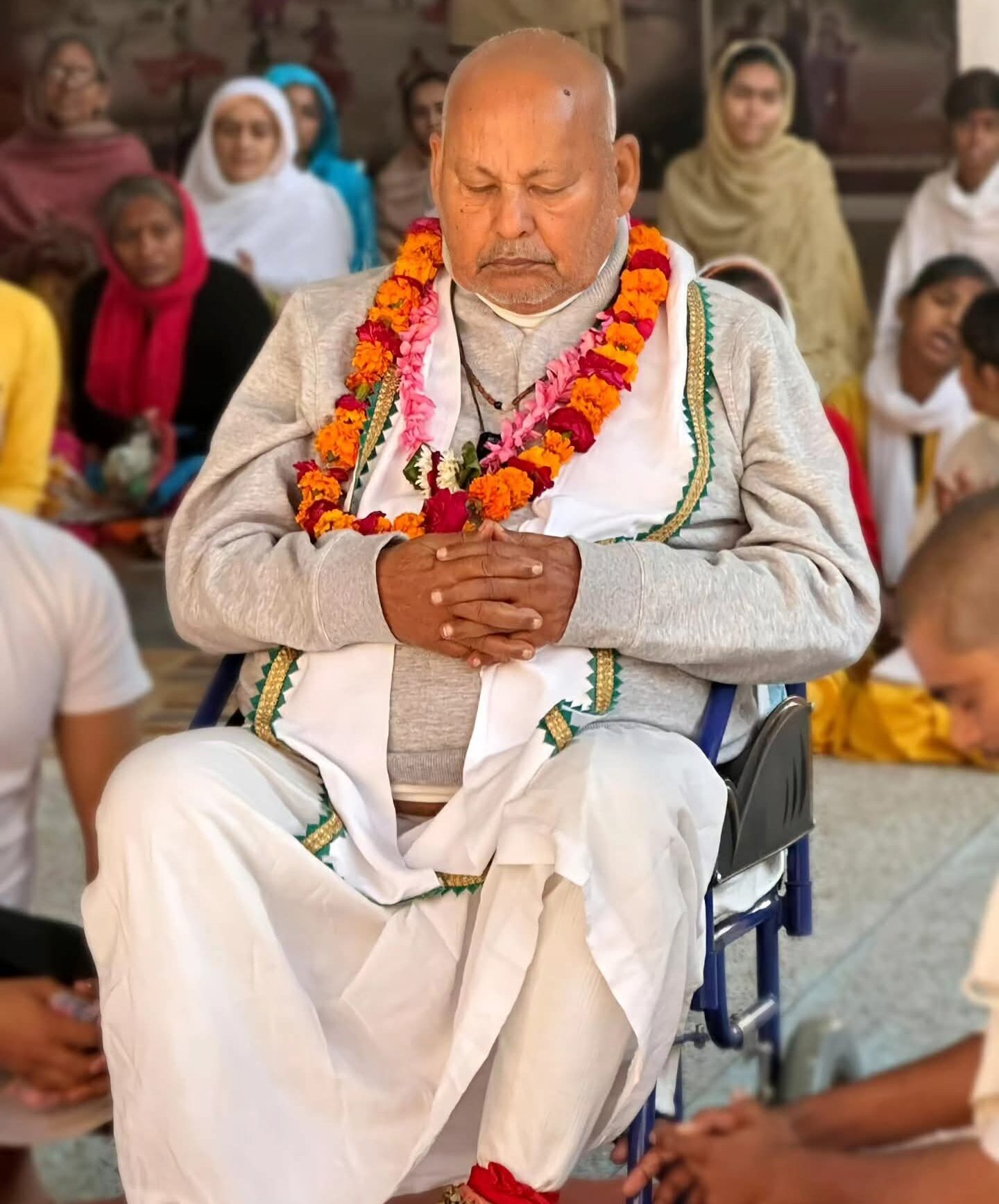
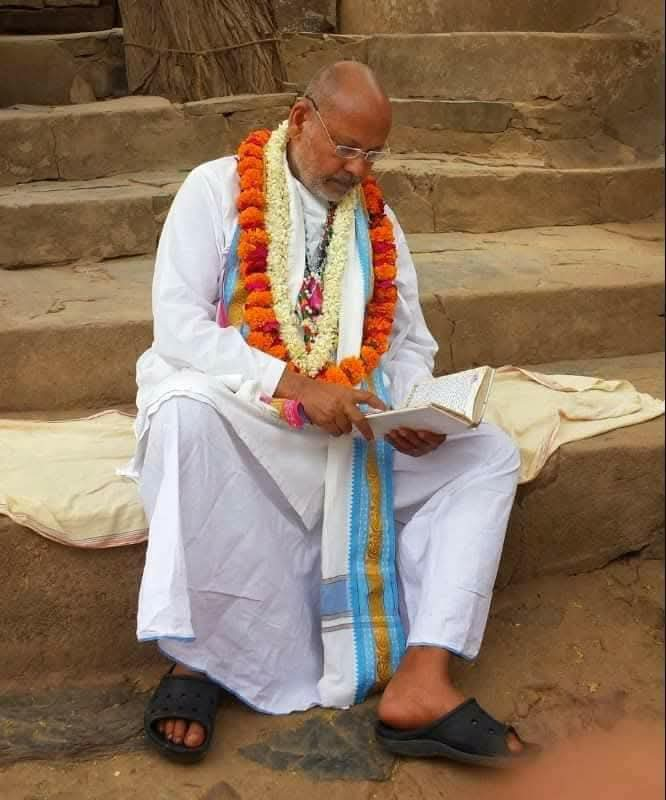
20th October, 2026, Barsana: He came to Barsana as a teenager, searching for the lush greenery he had seen on the silver screen. What he found was a landscape in decline. That disappointment became a lifelong mission to protect Braj’s forests, cows, the Yamuna and its sacred heritage.
Some stories begin by chance and eventually become history. The life of Ramesh Baba is one such story.
As a teenager in Prayagraj, Ramesh Kumar once skipped school with his friends to watch the celebrated Hindi film Jhanak Jhanak Payal Baaje, directed by V. Shantaram. The film’s enchanting landscapes and lush greenery left a deep impression on him. Believing that the beautiful Braj he had seen on screen existed in reality, he decided to visit Barsana.
But the landscape he encountered was very different from the one he had imagined. Instead of verdant forests, he found a region suffering from ecological degradation and neglect.
The young Ramesh Kumar was disappointed, but he did not return home. He resolved to restore the beauty of the land that had drawn him to Braj.
Ironically, the film’s lush green landscapes had been shot in Hyderabad, not Braj. A teenager had mistaken Hyderabad’s greenery for that of Braj and travelled to Barsana in search of it. Yet the disappointment he experienced there awakened a determination that would shape the rest of his life.
His family eventually brought him back to Allahabad, hoping he would abandon his new life. But he returned to Barsana, determined to remain within the traditional eighty-four-kos pilgrimage region of Braj. The hills of Gahvarvan became his home, and Ramesh Kumar gradually came to be known as Ramesh Baba.
His mother eventually accepted that her son would not return to his former life. She, too, moved to Barsana and lived in a small hut at the foot of Gahvarvan hill.
Baba told me that he had taken two lifelong vows: never to leave the eighty-four-kos Braj region and never to touch money. His commitment was not without danger; during his years on the hill, he also faced attacks from local mafias.
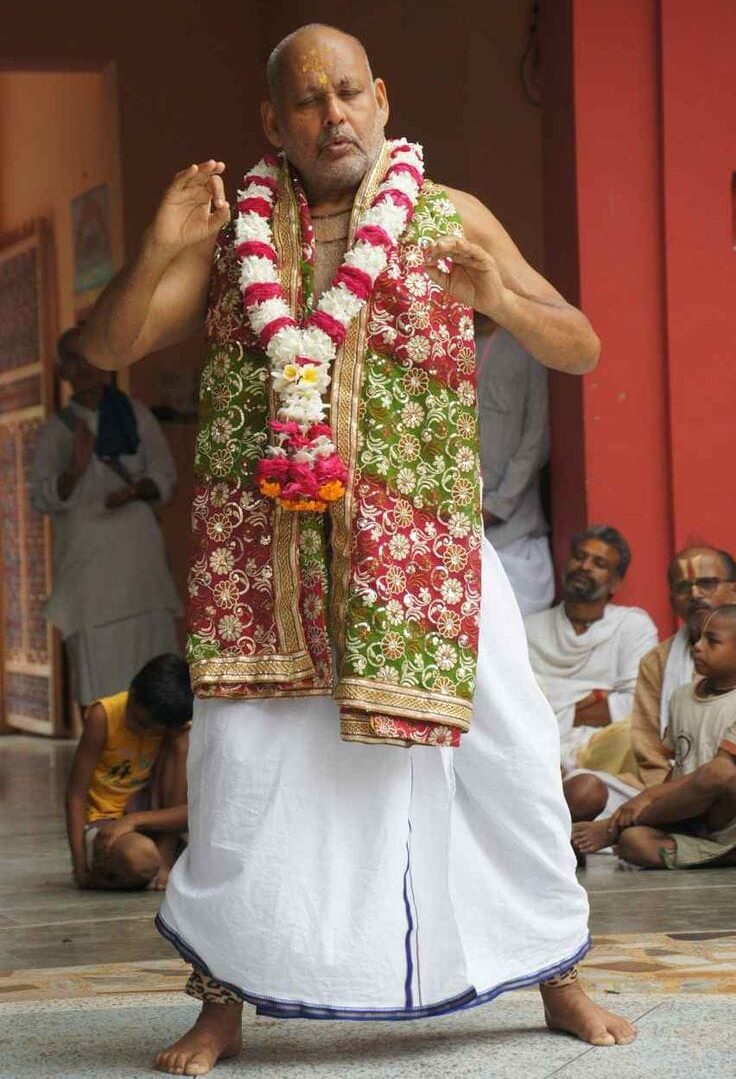
My first encounters with Ramesh Baba
I first came into contact with Ramesh Baba in 1995, when I returned from Agra to Mathura as the district bureau chief of Amar Ujala. At the time, Gahvarvan was not widely discussed beyond a small circle, and Baba was little known outside Braj.
However, after visiting Gahvarvan and observing his work closely, I realised that he was no ordinary saint. His concerns extended far beyond prayer and spiritual practice. He was deeply troubled by the destruction of Braj’s forests and the threats facing its cows, the Yamuna and its cultural traditions.
I began publishing reports on his work and the need to protect Gahvarvan prominently in Amar Ujala.
Friends, saints and acquaintances in Mathura and Vrindavan would sometimes ask me, “Sikarwar ji, why do you write so much about this Ramesh Baba? Who is he, after all?”
My answer was always the same: “Visit Gahvarvan once and see his work for yourself. Then you will understand why I write about him.”
I had numerous opportunities to sit with Baba at his hilltop ashram. He would speak at length about the environmental challenges facing Braj. For him, a forest was not merely a collection of trees; it was an integral part of the sacred landscape associated with the divine pastimes of Radha and Krishna.
He believed that if Braj’s forests disappeared, the region’s spiritual and cultural identity would also be diminished. Protecting Gahvarvan consequently became one of the defining campaigns of his life.
Taking the Forest Minister to Gahvarvan
In 1996, the then Uttar Pradesh Forest Minister, the late Raghuvar Dayal Verma, visited Mathura. A meeting was attended by the District Magistrate, the Divisional Forest Officer and other officials.
I felt that the authorities were not taking the proposal to declare Gahvarvan a reserved forest seriously enough. I raised the matter directly with the minister, whom I knew well, and urged him to visit the area personally.
Without a formal programme or elaborate arrangements, I took the minister and forest officials to Gahvarvan. Vanshidhar Agrawal, who was actively involved in the campaign to protect the forest, accompanied us.
Baba took us to the rooftop of his hilltop ashram and pointed towards the forest stretching into the distance. He explained how the area was gradually being destroyed and why urgent intervention was necessary.
That visit convinced me that Baba’s appeal was not simply an emotional plea but a warning about a serious environmental crisis. Subsequently, parts of Gahvarvan were declared reserved forest by the government.
Vanshidhar Agrawal’s contribution to this campaign deserves special recognition. His sustained efforts, alongside Baba’s determination and the support of others, helped strengthen the movement to protect Gahvarvan.
A gaushala with 60,000 cows
Baba’s commitment to cow protection was another defining aspect of his life. I once visited his Mataji Gaushala with my friend Anurag Agrawal, then Superintending Engineer in the Irrigation Department in Meerut, and several other friends. The sight of such a vast number of cows offered a glimpse of the scale of Baba’s commitment.
What particularly reassured me was the presence of a police outpost within the complex. Its establishment had followed a disturbing incident.
On another visit, my friend Satendra Singh of Bandi village and I met Baba. Radhakant Shastri ji and Sunil ji told us that the gaushala had recently been attacked. One employee had been murdered, and cows had been stolen.
Deeply disturbed, I immediately contacted my friend Arvind Kumar Jain, IPS, then Director General of Police in Uttar Pradesh. I explained that the area lay close to the Rajasthan border and that a permanent police presence was necessary to protect the gaushala, its staff and the cattle.
DGP Jain responded promptly. Acting on his directions, the then Senior Superintendent of Police, Manzil Saini, sent the Superintendent of Police (Rural) to the site the next day. A police outpost was established in two rooms within the gaushala premises.
When I visited later and saw the outpost, I felt a sense of relief. A concrete security arrangement had finally been put in place to protect Baba’s cows and the people caring for them.
The episode illustrated the practical challenges behind his mission. His work required not only devotion and determination but also effective law enforcement and institutional support.
“Sikarwar, we must save the Yamuna too”
My association with Ramesh Baba extended beyond Gahvarvan and the gaushala. He was concerned about the ecological well-being of the whole of Braj.
One day, he expressed grave concern about the deteriorating condition of the Yamuna and urged me to raise the issue on a larger platform.
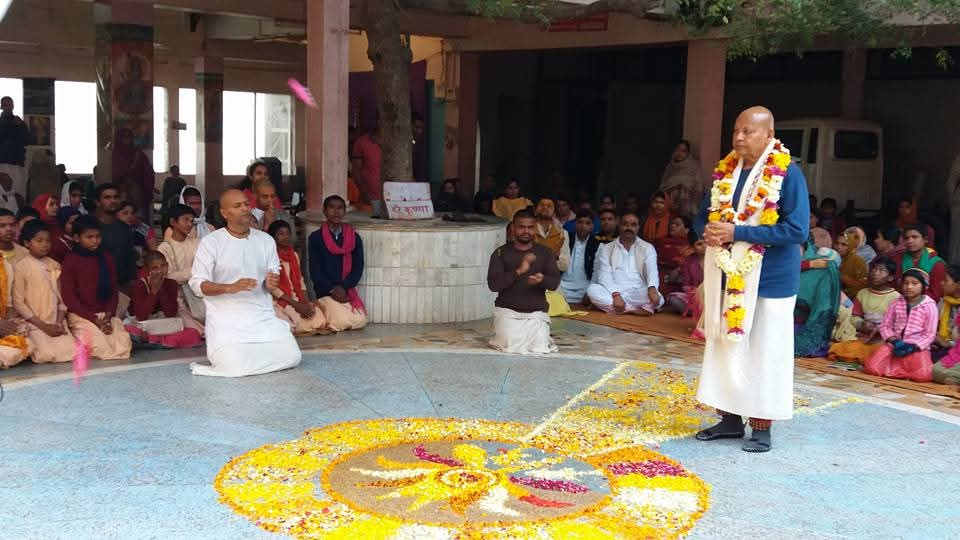
At his request, I initiated a campaign to save the Yamuna through Amar Ujala. I also took my editor, Rajendra Tripathi, to Baba’s ashram at Gahvarvan so that he could understand the saint’s concerns firsthand.
In 2001, I left Amar Ujala and joined Dainik Jagran in Meerut. Rajendra Tripathi subsequently gave substantial space in the newspaper to the Yamuna campaign.
A concern expressed by a saint on a forested hill thus gradually became a matter of wider public interest.
Baba understood that Braj’s environmental challenges could not be addressed in isolation. Its forests, the Yamuna, its cows and its sacred traditions formed an interconnected whole.
Vineet Narain’s role in sustaining Baba’s projects
Around two and a half decades ago, Vineet Narain also played an important role in strengthening the financial foundation of Baba’s initiatives.
At my request, he attended the Sharadotsava celebrations at Baba’s ashram. That visit marked the beginning of a close association between them.
Vineet Narain subsequently helped establish a more organised system for mobilising donations and financial support for Baba’s projects. This provided a more dependable foundation for the gaushala and other service initiatives.
His contribution demonstrated the importance of sustained resources and collective participation in supporting large-scale charitable work.
The story of Ramesh Baba’s achievements is therefore also the story of a wider movement, strengthened by conservationists, journalists, donors, citizens and public officials who supported his mission in different ways.
“My Padma Shri is Radha Rani”
One of the most revealing aspects of Baba’s personality was his indifference to worldly recognition.
Before he was conferred the Padma Shri, a high-level government team visited him and inspected his projects. During the visit, an official mentioned that the Government of India was considering him for the prestigious civilian honour.
Baba was unmoved.
“My Padma Shri is Radha Rani. What would I do with a piece of paper?” he reportedly replied.
His name was subsequently announced for the award. Yet he refused to travel to Delhi for the ceremony at Rashtrapati Bhavan because of his lifelong vow not to leave the Braj eighty-four-kos region.
Even after the ceremony, officials from the Union Home Ministry and Rashtrapati Bhavan made further attempts to persuade him to visit Delhi. He remained firm.
Eventually, the government arranged for the Padma Shri certificate to be presented to him at his Gahvarvan ashram through Shailjakant Misra, Vice-Chairman of the Uttar Pradesh Braj Teerth Vikas Parishad.
The episode captured the essence of Baba’s renunciation. The honour did not alter his priorities, and he would not abandon his vow even to receive one of India’s highest civilian recognitions in person.
Chief Minister Yogi Adityanath visited Baba at Gahvarvan on two occasions. Even during these meetings, Baba remained detached from ceremony and personal recognition. His conversations with the Chief Minister focused on Braj’s forests, the Yamuna and the need to protect the region’s natural and cultural heritage.
He had no personal demands to make. His concern was always for Braj.
A legacy that belongs to all of Braj
Today, as we remember Ramesh Baba, it would be inadequate to view his life merely as the spiritual journey of a saint.
He fought to protect Braj’s forests, devoted himself to the welfare of cows, raised his voice for the Yamuna and worked to preserve the cultural and spiritual traditions that make the region unique.
He helped people understand that Braj is not simply a pilgrimage destination. It is a living cultural and natural heritage whose survival depends on collective responsibility.
His journey was extraordinary because he did not merely admire Braj. He experienced its suffering, made its protection his life’s purpose and remained faithful to that commitment until the end.
Today, the winds still move across the hills of Gahvarvan, where Baba once sat and spoke about the future of Braj. The forests, the gaushala, the sacred sites and the Yamuna remain part of the landscape he cherished. Yet the responsibility he carried has not ended with him.
Preserving Braj is now a collective duty—one that belongs to its residents, saints, environmental activists, journalists, donors and government institutions alike.
We must also remember those who helped strengthen Baba’s mission: Vanshidhar Agrawal and other conservationists who fought for Gahvarvan; officials who supported forest protection and security; journalists who brought Braj’s concerns before the public; and donors who helped sustain his service projects.
For me, the memory will remain deeply personal. Nearly three decades ago, as a bureau chief of Amar Ujala, I encountered a saint on the hill of Gahvarvan whose concerns extended far beyond the walls of his ashram.
I came to understand that his renunciation did not mean withdrawal from the world. It meant giving up personal ambitions to serve something larger than himself.
He came looking for the green Braj he had seen in a film. He stayed to protect the Braj he found. And in doing so, he turned a teenager’s disappointment into a lifelong mission of conservation.
Ramesh Baba is no longer physically among us, but the resolve he embodied remains alive in the soil of Braj.
His life leaves us with a simple yet enduring message:
Save Braj. Protect its forests, its cows, its Yamuna and its sacred heritage. Keep the resolve of Ramesh Baba alive.

Support Vrindavan Today: Help us preserve the rich spiritual, cultural and environmental heritage of Braj. Your generous contribution will strengthen our efforts to document Vrindavan’s timeless traditions, protect its sacred heritage and raise a voice for the conservation of Braj. Every donation, big or small, helps us continue this mission. Donate today and become a part of our journey to preserve the soul of Braj. You can sponsor articles also. Donation made to Vrindavan Today is tax exempt u/s 80 G of the IT act. You can also help us by placing order of an advertisement of your product, which we will publish here in this site. Email us on: [email protected] or whatsapp us on 7456930889